If your mechanic has just told you the engine is gone, you’ve probably started Googling replacement options and run straight into the term “reconditioned engine”. It gets thrown around loosely in Australia, and because there’s no government-regulated standard for what counts as reconditioning, it pays to understand exactly what you’re buying before you hand over thousands of dollars.
The short answer: A reconditioned engine is a used engine that has been fully stripped down, cleaned, measured, machined and rebuilt with new wear parts, then tested before sale. It sits between a second-hand engine and a brand-new one on both price and risk, and a good one should behave like a much younger engine.
What does engine reconditioning actually involve?
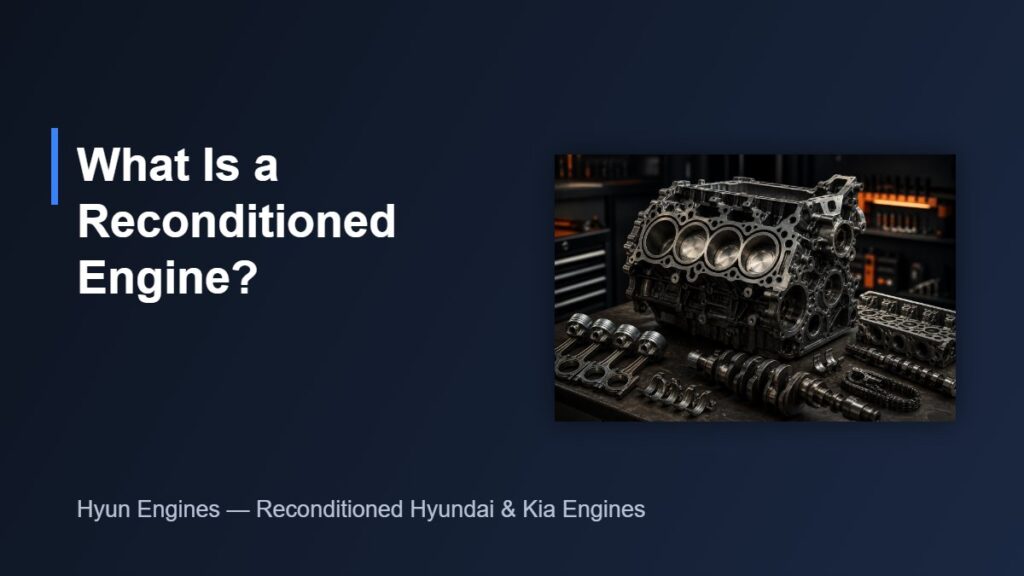
Proper reconditioning is a workshop process, not a clean and repaint. A donor engine is pulled down to a bare block, and every major component is inspected and measured against factory tolerances. The typical steps look like this:
Strip and clean. The engine is completely disassembled and hot-washed so cracks, scoring and wear can actually be seen and measured.
Machining. The block is checked for straightness and the cylinders are honed (or bored and fitted with oversize pistons) so the rings can seal properly. The crankshaft journals are ground and polished, and the cylinder head is resurfaced with valves and seats recut to seal correctly.
New wear parts. Bearings, piston rings, gaskets, seals and oil pump are replaced as a matter of course, and timing components are renewed where needed. On chain-driven Hyundai and Kia engines, this is the right time to fit a new timing chain kit rather than reuse a stretched one.
Assembly and testing. The engine is rebuilt to correct torque specs and clearances, then tested — compression and oil pressure at a minimum — before it’s sold.
That last point matters. Because “reconditioned” isn’t a legally defined term in Australia, some sellers use it for engines that have had little more than new gaskets. Always ask what was actually machined and replaced.
How is a reconditioned engine different from used or new?
Here’s how the three options compare for a typical Hyundai or Kia four-cylinder:
| Second-hand engine | Reconditioned engine | New engine | |
|---|---|---|---|
| What you get | An engine pulled from a wrecked car, sold as-is | A stripped, machined and rebuilt engine with new wear parts | A factory-fresh engine from the manufacturer |
| Internal condition | Unknown — you inherit its history | Inspected, machined and renewed | Brand new |
| Typical warranty | Often 30–90 days | 12 months from a reputable supplier | Manufacturer warranty |
| Typical cost | Lowest | Mid-range | Highest — often uneconomical on an older car |
| Best suited to | Older cars you won’t keep long | Cars you plan to keep driving for years | Near-new vehicles |
A new engine from a dealer can cost more than an older car is worth, while a second-hand engine is a gamble on someone else’s servicing habits. Reconditioned sits in the middle: you pay more than wrecker prices, but the wear items that usually kill these engines have already been dealt with.
Why buy a reconditioned engine?
The case is mostly about known condition. Common Hyundai and Kia failure points — worn bearings, stretched timing chains, oil-burning rings on some GDI engines — are exactly the parts a proper recondition replaces. You’re not hoping the engine is good; it has been measured and corrected.
There’s also the warranty gap. A wrecker engine with a 30-day warranty gives you barely one oil change of protection. Every engine we sell at Hyun Engines carries a 12-month warranty, which reflects the fact that the engine has been through the full strip, machine and test process before it goes out the door.
Finally, it’s usually faster than rebuilding your own engine. An exchange reconditioned engine is ready to fit, so your car can be back on the road in days rather than the weeks a machine-shop rebuild of your original engine can take.
What should you check before buying one?
Not all “reconditioned” engines are equal. Before you buy from anyone — including us — ask these questions:
What work was actually done? You want specifics: machined block or head, new bearings, rings, seals, timing components. Vague answers are a red flag.
Was it tested, and how? Compression and oil pressure test results should exist for the exact engine you’re buying.
What’s the warranty, in writing? Twelve months is a fair benchmark for a properly reconditioned engine. Check what the warranty requires — most are conditional on correct installation and servicing.
Does the engine match your car? Hyundai and Kia used several variants of the same engine family across years and models. A specialist can match the engine code (for example G4NB, G4NC, G4KJ or G4FC) to your VIN so you don’t end up with a near-miss that won’t bolt up cleanly.
Who is fitting it? A good engine installed badly will fail. Using a supplier who also fits the engine — so one business is responsible for the whole job — removes the finger-pointing if anything goes wrong.
Where can you buy a reconditioned Hyundai or Kia engine in Melbourne?
Hyun Engines has specialised in reconditioned Hyundai and Kia engines since 2014. You can browse current stock of reconditioned Hyundai engines and Kia engines online, or have the whole job handled with our engine supply and fit service at our Dandenong workshop (8 Hammond Rd, Dandenong VIC 3175). Every engine comes with a 12-month warranty. Call (03) 9630 0960, Monday to Friday 9am–5pm, or get in touch online for a quote on your exact model.
Frequently Asked Questions
How long does a reconditioned engine last?
A properly reconditioned engine with new bearings, rings and timing components should last for many years of normal driving — often comparable to a healthy engine of the same type — provided it’s installed correctly and serviced on schedule with the right oil.
Is a reconditioned engine the same as a remanufactured engine?
They’re close cousins. “Remanufactured” usually implies a factory-style process built strictly to original specifications, while “reconditioned” is the common Australian term for the same strip, machine, renew and test process carried out by a specialist workshop. The key in both cases is what was actually replaced and tested.
Does a reconditioned engine come with a warranty?
It should. Reputable suppliers back their work — every engine from Hyun Engines includes a 12-month warranty. Be cautious of any “reconditioned” engine offered with only a 30-day warranty, as that’s typical of untested second-hand stock.
Will a reconditioned engine affect my car’s resale value?
Usually it helps. A documented reconditioned engine with a warranty and receipts is a selling point on a higher-kilometre car, because the buyer knows the most expensive component has already been renewed.