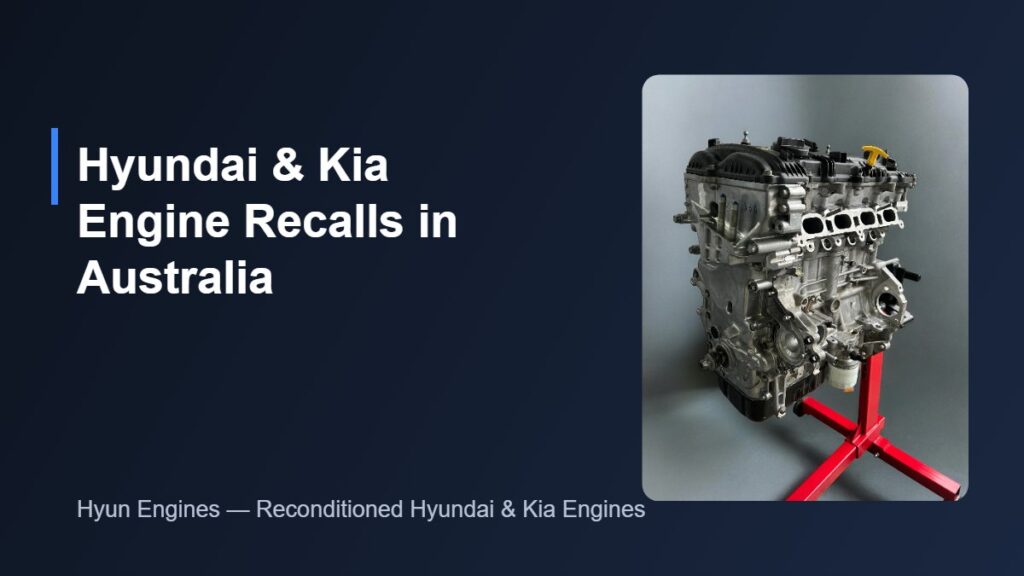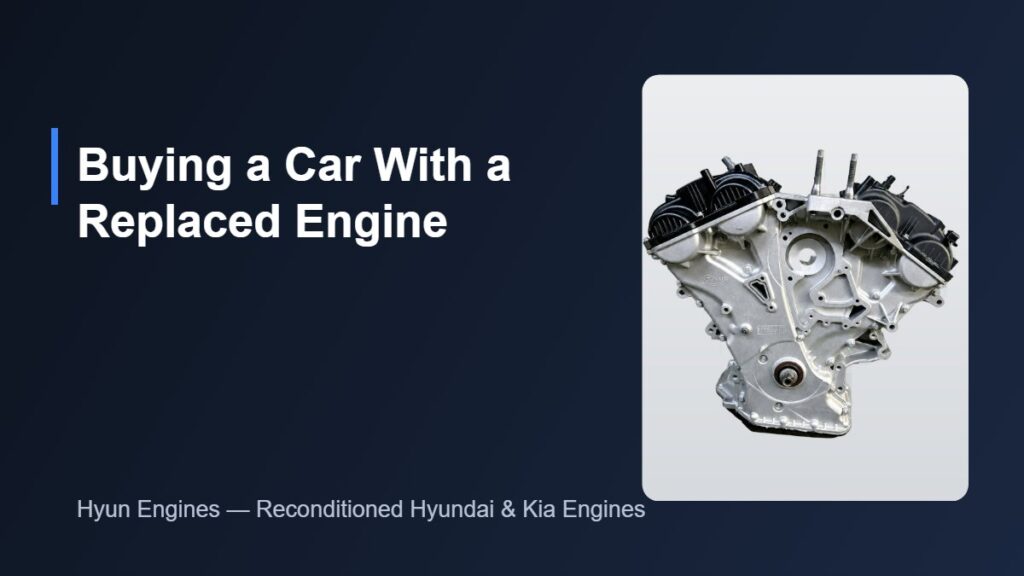
You’ve found a used car at the right price, the test drive went well — and then the seller mentions the engine was replaced. For a lot of buyers, that’s where the deal dies. It shouldn’t be, at least not automatically. A replaced engine can mean a car that was neglected and patched up, or it can mean the most expensive component in the car is younger than everything around it. The difference comes down entirely to documentation, and knowing what to check takes about an hour.
The short answer: A replaced engine isn’t automatically a red flag — a documented, professionally fitted reconditioned engine can actually be a plus, since the engine has far fewer kilometres than the car. The deal-breakers are missing paperwork, an engine number that doesn’t match the records, and no explanation for why it was replaced.
Why was the engine replaced in the first place?
This is the question that frames everything else. Plenty of engine replacements have perfectly ordinary causes: a known factory weak point (Hyundai and Kia’s Theta II bearing issues are a well-documented example), an overheating event from a failed water pump, or simple high-kilometre wear on an otherwise good car. Our guide on when a Hyundai engine needs replacing runs through the common scenarios.
What you’re listening for is a specific, verifiable story: “the Theta II spun a bearing at 160,000 km, we fitted a reconditioned engine with an invoice to prove it” is a good answer. “Not sure, previous owner did it” is not disqualifying, but it shifts all the weight onto the paperwork. A seller who is vague about why, when and who did the work is asking you to buy blind.
What paperwork should the seller be able to show you?
A legitimate engine replacement leaves a paper trail. Ask for the engine supplier’s invoice (which should identify the engine by code and number), the workshop’s fitting invoice showing the date and odometer reading, any warranty documentation for the replacement engine, and ideally service records since the swap. A reconditioned engine from an established supplier typically comes with a written warranty — every engine Hyun Engines has supplied since 2014 carries a 12-month warranty, and documentation like that transfers real value to the next owner. Ask whether any engine warranty is transferable and get that in writing.
How do you verify the engine number against the records?
Every engine carries a unique number stamped on the block, and that number is recorded against the vehicle’s registration in every Australian state. Your checks, in order:
| Check | Where | What you’re confirming |
|---|---|---|
| Engine number on the block | Stamped on the engine (location varies by model) | It matches what the invoices say was fitted |
| Registration records | State rego check / transport authority | The current engine number has been updated on the rego |
| PPSR certificate ($2) | ppsr.gov.au, search by VIN | No finance owing, not recorded stolen or written off |
| Engine code vs the car | Invoice and VIN decode | The fitted engine is the correct variant for the vehicle |
An engine number that doesn’t match the registration records isn’t necessarily sinister — owners sometimes simply fail to update the rego after a replacement — but it must be explainable and fixable before you buy. An unexplained mismatch on a car with no replacement paperwork is where you walk away, because it can indicate an undisclosed history you can’t assess.
What are the genuine red flags?
Walk away, or at least price accordingly, when you see: no invoices for the engine or the fitting; an engine number mismatch nobody can explain; a replacement done “by a mate” with no workshop involved; signs the swap was rushed — mismatched or missing bolts, zip-tied wiring, fresh oil leaks around the engine; a seller who won’t allow an independent inspection; or a car where the engine was replaced but the cause of the original failure (cooling system, oil sludge) was never addressed. Any one of these is a caution flag; two or more is a pattern.
When is a replaced engine actually a selling point?
Flip the scenario: a 2016 Sportage with 180,000 km on the body but a properly reconditioned engine fitted 30,000 km ago, with invoices, a warranty and rego records updated. Mechanically, the most failure-prone and expensive part of that car is far newer than the odometer suggests — and on models with known engine weak points, the replacement may well be more durable than the original ever was, because reconditioning addresses the failure mode. A car like that, priced like any other high-kilometre example, can be the best value on the market. The documentation is what converts “engine replaced” from a discount into an asset.
This works in reverse, too: if you’re keeping your own car and its engine is failing, a documented reconditioned replacement protects the car’s resale story. Fit a properly warranted engine now and you’re not just buying kilometres — you’re buying the paperwork the next buyer will want to see.
Whether you’re buying a car with a replaced engine or replacing one before you sell, Hyun Engines can help you get the documentation right. We supply reconditioned, tested Hyundai and Kia engines — browse the engine range, from Sportage G4KJ units to the Elantra G4NB — with a 12-month warranty on every engine and full supply and fit at our Dandenong workshop. Call (03) 9630 0960, Mon–Fri 9am–5pm, 8 Hammond Rd, Dandenong VIC 3175.
Frequently Asked Questions
Does a replaced engine lower a car’s value?
Without paperwork, usually yes, because buyers can’t verify the work. With invoices, a warranty and updated rego records, a recently replaced engine can hold or even lift value on a high-kilometre car.
Does the odometer reset when an engine is replaced?
No. The odometer records the vehicle’s distance, not the engine’s, and altering it is illegal in Australia. The fitting invoice showing the odometer reading at installation is what establishes the engine’s true kilometres.
Do I need to update the rego when an engine is changed?
Yes. Australian states record the engine number against the registration, so the new engine number should be updated with your state transport authority after a replacement. Buyers should check this has been done.
Is a reconditioned engine as good as the original?
A properly reconditioned engine is rebuilt with worn components replaced and is tested before sale — on engine families with known weak points, it can be more dependable than the original. Every engine we supply is covered by a 12-month warranty.