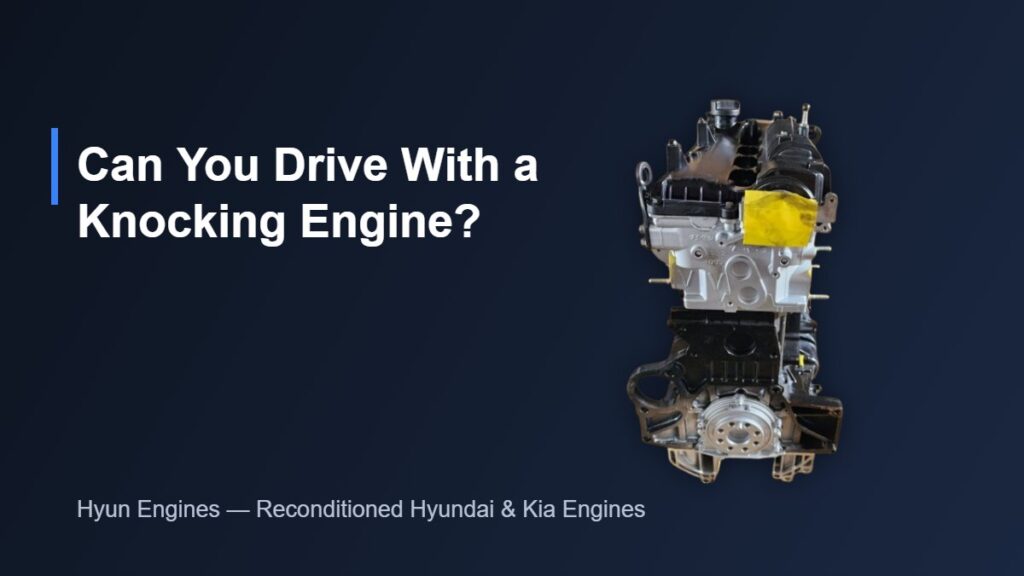
A knocking noise from the engine has a way of appearing at the worst possible time — and the temptation is always to keep driving “just until the weekend” or “just until payday”. Sometimes that gamble costs nothing. Sometimes it turns a repairable engine into scrap metal in under an hour. Having assessed hundreds of knocking Hyundai and Kia engines at our Dandenong workshop, here’s how to tell the difference and what to do right now.
The short answer: No — not if the knock is deep, rhythmic and gets louder under acceleration. That pattern points to worn connecting rod bearings, and continued driving can destroy the engine within minutes to days. Stop, check the oil, and have the car towed or assessed before driving further.
Which knocking noises are urgent — and which aren’t?
Not every noise from the engine bay is a death sentence. The details — when it happens, where it comes from, how it changes with revs — tell you how much trouble you’re in:
| Noise | Typical cause | Urgency |
|---|---|---|
| Deep knock that speeds up with revs and worsens under load | Connecting rod bearing wear (“rod knock”) | Stop driving now |
| Loud rattle on cold start that fades in seconds | Timing chain tensioner or piston slap | Book an inspection soon |
| Light metallic rattle when accelerating up hills | Detonation (“pinging”) — fuel octane or carbon build-up | Address promptly; try higher-octane fuel |
| Rhythmic ticking that rises with revs | Lifters or valvetrain, often oil-related | Check oil level and book an inspection |
| Knock only over bumps | Engine mount, exhaust or suspension contact | Not engine-internal; inspect at next service |
The dangerous one is the first row. Rod knock is a deep, hollow, rhythmic sound — often compared to a hammer on a metal drum — that tracks engine speed and gets distinctly louder when you accelerate or put the engine under load. On Hyundai and Kia’s Theta II engines in particular, this is the classic symptom of bearing failure, and it does not improve on its own. Our guide to engine noises in Hyundai motors covers the full range of sounds in more detail.
What happens if you keep driving with rod knock?
The bearing surface is already damaged, which means metal is contacting metal on every rotation — over a hundred times a second at highway speed. Each rotation wears the bearing further, sheds metal particles into the oil, and increases the clearance so the knock hits harder. From there the failure cascades: the crankshaft journal gets scored, the debris-laden oil damages other bearings, and in the worst case the connecting rod lets go entirely — which can punch through the engine block and end the engine on the spot, sometimes with an oil fire risk and a sudden loss of drive in traffic.
The financial difference is stark. Caught at the first knock, the engine may be repairable or rebuildable, or at worst you’re paying for a replacement engine. Driven until it lets go, you can add a damaged block, and potentially towing from wherever it died. Continuing to drive doesn’t save the repair bill — it grows it.
What should you do the moment you hear a knock?
First, stop somewhere safe and check the oil level. Low oil is both a common cause of knocking and the fastest way to accelerate the damage — if the dipstick reads low, top up with the correct grade before the engine turns another revolution. Second, listen again after topping up: if the knock persists, especially a deep load-related knock, don’t drive on. Third, arrange a tow or, at minimum, a very short low-speed drive to a workshop — every kilometre under load makes the outcome worse. Finally, get a proper assessment before anyone talks you into either extreme: not every knock needs a new engine, and not every knock can be fixed with an oil change.
Can a knocking engine be repaired, or does it need replacing?
It depends entirely on how early you caught it. A knock caused by low oil, detonation or a valvetrain issue can often be resolved without major surgery, and some bottom-end damage caught very early can be handled with an engine rebuild. But once a rod bearing has spun or the crankshaft is scored — which is common by the time a knock is clearly audible — a complete reconditioned engine is usually cheaper and far more reliable than machining a damaged block. On high-kilometre Theta II and Nu engines especially, replacement is often the smarter spend, because the rest of the original engine has the same wear as the part that failed.
How do you avoid the knock coming back?
Whatever engine ends up in the car, the protection is the same: oil. Keep the level checked monthly, change it on schedule with the correct grade, and never ignore the oil pressure light — it is the last warning before bearing damage begins. If your engine has a known appetite for oil, shorten the check interval, not the top-up amount.
If your Hyundai or Kia is knocking, don’t gamble on it. Hyun Engines has supplied reconditioned, tested engines since 2014, every engine carries a 12-month warranty, and our Dandenong workshop handles complete engine supply and fit — typically 2 to 3 days once the engine is on hand. Call (03) 9630 0960 (Mon–Fri 9am–5pm) or get in touch online and we’ll help you work out whether it’s a repair, a rebuild or a replacement — 8 Hammond Rd, Dandenong VIC 3175.
Frequently Asked Questions
How long can I drive with a knocking engine?
With genuine rod knock, potentially only minutes — there’s no safe figure. Some engines limp on for days, others let go on the next hard acceleration. Treat a deep load-related knock as a stop-now fault.
Can an oil change fix engine knock?
If the knock was caused by a low level or badly degraded oil and was caught immediately, topping up or changing the oil can quieten it. If the knock persists with fresh oil at the correct level, the bearing damage is already done and needs assessment.
Why do Hyundai and Kia engines knock more than some other brands?
The Theta II family has a documented history of premature rod bearing wear, and Nu engines can run low on oil through gradual consumption. Both end in the same deep knock, which is why oil-level discipline matters so much on these engines.
Is it worth fixing a knocking engine on an older car?
Often, yes. If the body, transmission and interior are sound, a reconditioned engine costs far less than changing cars — and with a 12-month warranty on every engine we supply, it comes with more certainty than a used-car gamble.