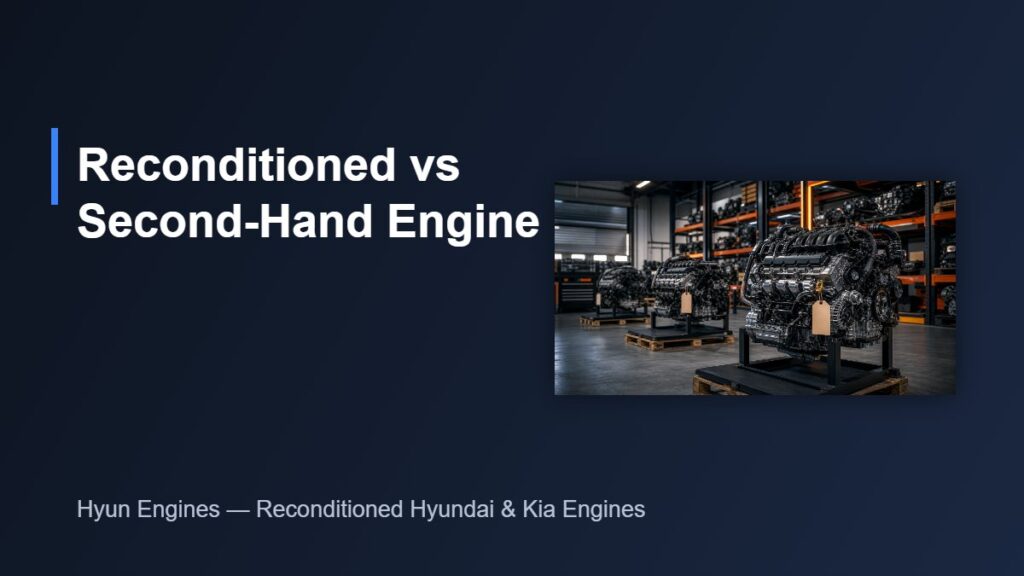
When an engine dies, most owners face the same fork in the road: a cheap second-hand engine from a wrecker, or a dearer reconditioned unit from a specialist. The price gap can be a couple of thousand dollars, so it’s a fair question — and the honest answer is that each option suits a different situation. What matters is understanding exactly what you’re getting for the difference.
The short answer: A second-hand engine is cheaper up front but its internal condition is unknown and warranties are short. A reconditioned engine costs more but has been stripped, machined, fitted with new wear parts and tested, usually with a 12-month warranty. If you’re keeping the car, reconditioned is almost always the safer money.
What’s the actual difference between the two?
A second-hand (used) engine is pulled from a written-off or dismantled vehicle and sold essentially as it came out. The wrecker may have heard it run or done a compression test, but nobody has seen inside it. Its bearings, rings, timing chain and oil galleries are whatever the previous owner’s servicing left them.
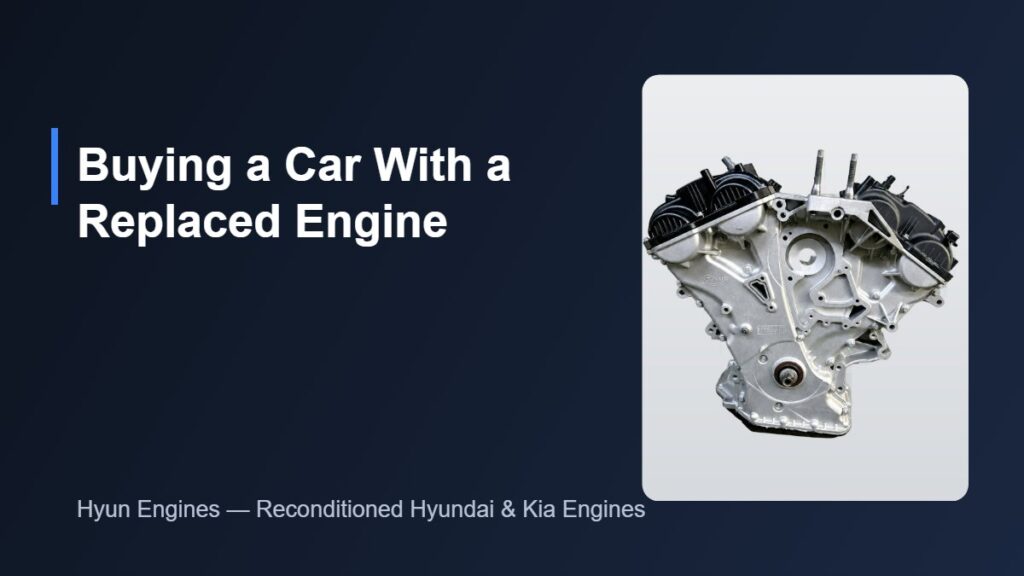
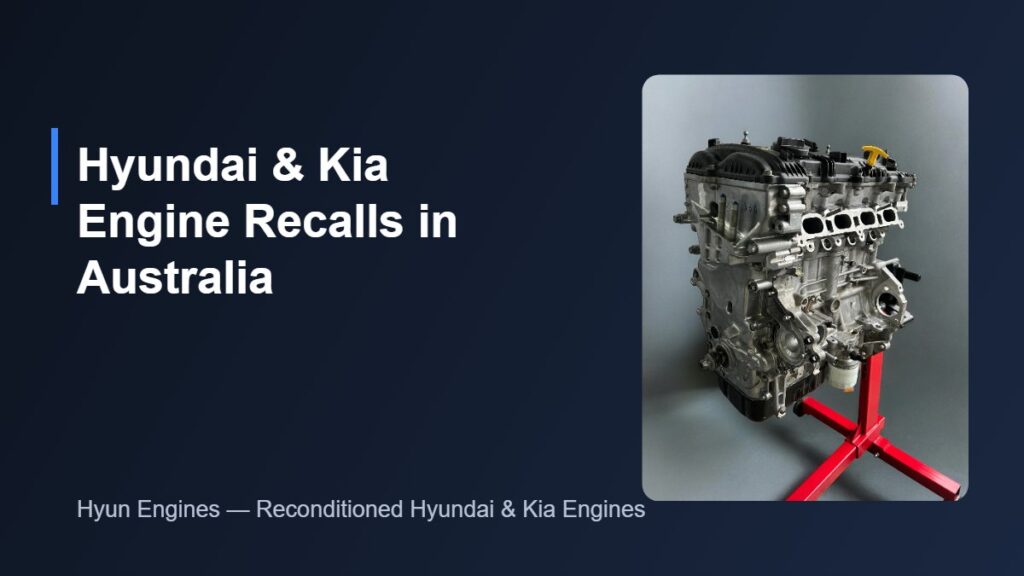
A reconditioned engine started life the same way — but it has since been fully disassembled, cleaned, measured, machined where needed, rebuilt with new bearings, rings, gaskets, seals and timing components, and then tested. You’re buying a known quantity: the parts that usually kill high-kilometre Hyundai and Kia engines have already been replaced.
How do the risks compare?
| Risk factor | Second-hand engine | Reconditioned engine |
|---|---|---|
| Internal wear | Unknown — inherited from donor car | Measured and corrected during rebuild |
| Service history | Usually unknown | Irrelevant — wear parts are new |
| True kilometres | Often unverifiable | Core kilometres don’t carry the same risk once machined and renewed |
| Known model weak points (oil burning, worn bearings, stretched chains) | May arrive with the same fault that’s about to kill your engine | Addressed as part of reconditioning |
| Typical warranty | 30–90 days, often parts-only | 12 months from a reputable supplier |
| Cost | Roughly $1,500–$4,000 | Roughly $4,200–$7,999 for Hyundai/Kia units |
| If it fails at month four | Your problem | Warranty claim |
That last row is the one people forget. Paying twice — a second engine plus a second round of fitting labour — usually erases everything the used engine saved you, and fitting labour is never refunded under a short parts-only warranty.
When does a second-hand engine make sense?
There are genuine cases for going used. If the car is old, worth little, and you only need it to survive another year or two, a cheap engine can be rational. Low-kilometre donor engines from lightly damaged imports can also be decent value when the history is verifiable. And for some rare or discontinued engines, second-hand may be the only option available.
The catch with Hyundai and Kia specifically: the engines most commonly needed — think i30, Tucson, Cerato and Sportage four-cylinders — are needed precisely because those engine families wear in well-documented ways. A used G4NB or G4NC from a wrecker has, statistically, been living the same life as the one that just failed in your car. Buying your problem back with different kilometres on it is a real risk.
When is a reconditioned engine the better buy?
Choose reconditioned when you plan to keep the car for years, when the replacement is going into a vehicle you rely on daily, or when the engine family has known wear issues you want properly engineered out rather than inherited. It’s also the better choice whenever total cost of ownership matters more than the invoice: one reconditioned engine with a 12-month warranty is routinely cheaper over three years than a used engine plus the odds of doing the job twice.
At Hyun Engines, every engine in our Hyundai range and Kia range is reconditioned and tested before sale, and carries a 12-month warranty — we’ve specialised in these two makes since 2014.
What questions should you ask before buying either?
Whichever way you lean, put these to the seller:
For a second-hand engine: What vehicle did it come from, and what were its kilometres? Was it compression tested — can I see the numbers? What exactly does the warranty cover, and does it include labour if the engine fails after fitting?
For a reconditioned engine: What was machined, and which parts were replaced? Was the timing chain or belt kit renewed? Was it tested after assembly? Is the 12-month warranty in writing, and what are its conditions?
For both: Is this the correct engine code for my VIN? Hyundai and Kia ran multiple variants within the same family, and a near-match can mean sensor, mounting or ECU headaches. And who’s accountable if something goes wrong — the seller, the fitter, or nobody?
That last question is why supply-and-fit from one business is worth considering: with our engine supply and fit service, Hyun Engines supplies the reconditioned engine and installs it at our Dandenong workshop, so one business stands behind the whole job. Call (03) 9630 0960 (Mon–Fri 9am–5pm), visit us at 8 Hammond Rd, Dandenong VIC 3175, or request a quote online — we’ll match the right engine to your VIN before you spend a cent.
Frequently Asked Questions
Are second-hand engines from wreckers tested?
Sometimes, but usually only externally — a run-up or a compression test at best. Nobody has inspected the bearings, bores or timing components inside. That’s the fundamental difference from a reconditioned engine, which has been disassembled and measured.
How much more does a reconditioned engine cost than a used one?
Typically $2,000–$4,000 more for common Hyundai and Kia four-cylinders. Against that, you get new wear parts, machining, testing and a 12-month warranty — and you avoid the real possibility of paying fitting labour twice.
Can I buy a second-hand engine and have it reconditioned?
Yes — that’s essentially what a rebuild is, using your existing or a donor engine as the core. It can work out well if the core is sound, but by the time you add machining and parts, an exchange reconditioned engine is often similar money with less waiting.
Does a reconditioned engine last as long as a new one?
A properly reconditioned engine with new wear parts, correct installation and regular servicing can deliver many years of reliable use. The machining brings critical surfaces back to specification, so longevity depends mainly on maintenance — same as any engine.