“Reconditioned”, “rebuilt”, “remanufactured” — the engine trade uses these words loosely, and workshops don’t always mean the same thing by them. If you’re comparing quotes and one says “rebuild” while another says “reconditioned exchange engine”, you’re not comparing apples with apples. Here’s what the terms actually mean in the Australian trade, and how to work out which path suits your situation.
The short answer: A rebuild means your own engine is removed, stripped, machined and restored, then refitted to your car. A reconditioned exchange engine is a different engine that has already been through that same process — it’s swapped in so you’re back on the road in days. The workshop processes overlap almost entirely; the difference is whose engine gets the work, and how long you wait.
What does “rebuilding” your engine mean?
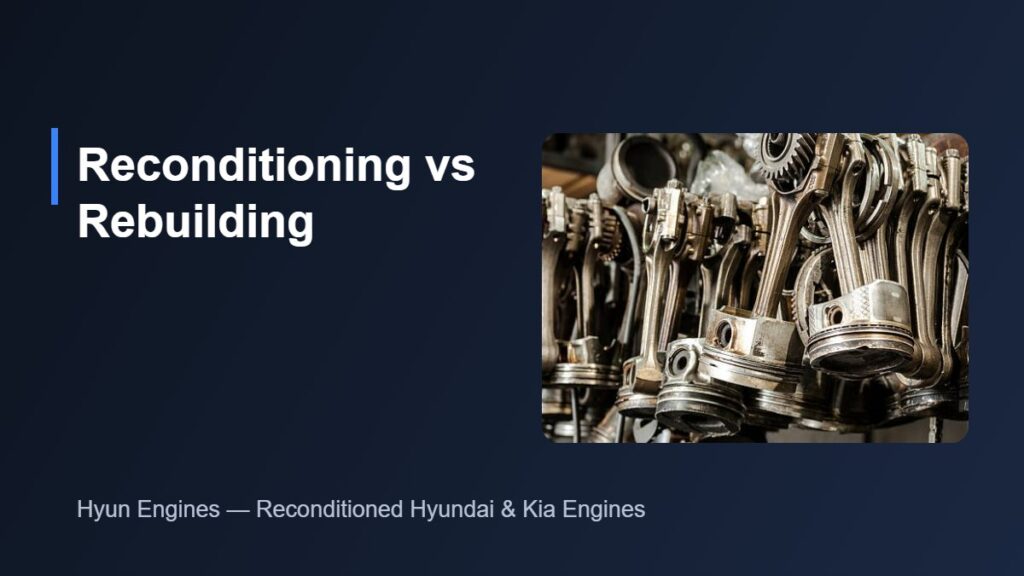
A rebuild keeps your original engine. It comes out of the car and is stripped to a bare block. Everything is cleaned, measured and inspected, then the necessary machining happens: cylinders honed or bored, crankshaft ground and polished, head resurfaced, valves and seats recut. New bearings, rings, gaskets, seals and timing components go in, and the engine is reassembled to factory clearances, tested, and refitted.
Because the scope depends on what the strip-down reveals, a rebuild is partly an open cheque — most Hyundai and Kia four-cylinder engine rebuilds at Hyun Engines land around the $4,000 mark, but severe damage (a cracked block, a crank run without oil) can move the number. The trade-off for that uncertainty is that you keep your numbers-matching original engine, which some owners value.
What is a reconditioned exchange engine?
A reconditioned engine has already been through the same strip, machine, renew and test process — before you ever needed it. It sits on the shelf ready to go, so the job becomes a straightforward swap: your old engine out, the reconditioned unit in, your old engine typically returned as the exchange core.
The two practical advantages are speed and price certainty. There’s no waiting for machining, and the price is known up front because the internal work is already done — our reconditioned Hyundai and Kia engines are listed with firm prices in the online shop, and every one carries a 12-month warranty.
How much do the processes actually overlap?
Almost completely — and this surprises people. A properly reconditioned exchange engine and a properly rebuilt engine have had the same things done to them:
Both are stripped to the block and hot-washed. Both are measured against factory tolerances. Both get machining where needed — bores, crank journals, head surface. Both receive new bearings, rings, gaskets, seals and timing components. Both are assembled to spec and tested before running in a car.
In other words, “rebuild vs reconditioned” is not a quality difference when both are done properly. It’s a logistics difference: a rebuild applies the process to your engine while you wait; an exchange engine applies it to an identical engine in advance. (One caveat: in some parts of the trade, “rebuilt” can mean a minimal repair — fix only what broke. That’s another reason to always ask for the parts and machining list rather than relying on the label.)
Which option suits which situation?
| Rebuild your engine | Reconditioned exchange engine | |
|---|---|---|
| You need the car back fast | Weeks off the road | Usually days — best choice |
| Price certainty matters | Scope can grow with what’s found inside | Fixed, listed price |
| Your block is badly damaged | May be unrebuildable or costly | Sidesteps the damaged core entirely |
| You want your original engine kept | Yes — numbers-matching preserved | No — engine is exchanged |
| Rare engine, no exchange stock | Often the only option | Subject to availability |
| Warranty | Workshop warranty on the rebuild | 12-month warranty on every Hyun Engines unit |
What about cost and downtime?
For common Hyundai and Kia four-cylinders the totals often land close together: a rebuild around $3,500–$5,500 depending on damage, an exchange engine at $4,200–$7,999 plus fitting. The bigger practical difference is downtime — one to three weeks for a rebuild versus a few days for an exchange swap. If the engine failed because of a stretched or jumped timing chain, it’s also worth reading about our timing chain repair service — caught early, a chain kit can save the engine before either option is needed.
If you’re still weighing it up, our guide to Hyundai engine rebuilds goes deeper on what a rebuild involves for specific engine families.
Hyun Engines does both jobs under one roof at 8 Hammond Rd, Dandenong VIC 3175 — full engine rebuilds, and reconditioned exchange engines supplied and fitted — and we’ve specialised in Hyundai and Kia since 2014. Every engine comes with a 12-month warranty. Call (03) 9630 0960, Monday to Friday 9am–5pm, and we’ll tell you honestly which path is cheaper and faster for your exact engine.
Frequently Asked Questions
Is a reconditioned engine better than a rebuilt engine?
Neither is inherently better — when done properly, both have been stripped, machined, fitted with new wear parts and tested. The exchange engine wins on speed and price certainty; the rebuild wins if you want to keep your original engine or no exchange unit exists for your model.
Do I get to keep my old engine with an exchange unit?
Normally no — your old engine becomes the exchange core, which is part of how exchange pricing works. If keeping your original engine matters to you, a rebuild is the right path.
Which is faster, a rebuild or an exchange engine?
An exchange engine, by a wide margin. The machining and assembly are already done, so the job is limited to removal and installation — typically a few days, versus one to three weeks for a full rebuild.
What does “remanufactured” mean then?
Remanufacturing is a factory-style version of the same idea: an engine returned to original specification under a standardised industrial process. In the Australian trade, a thorough reconditioned engine from a specialist workshop covers the same ground — what matters is the documented parts list, machining and testing, not the label.