When your engine has failed, the first question is usually about cost — but the second, almost immediately, is time. How long will the car be off the road? Can you get by with one car for a week? Do you need a rental? Having fitted reconditioned Hyundai and Kia engines at our Dandenong workshop since 2014, we can give you a straight answer, plus a realistic breakdown of what speeds the job up and what slows it down.
The short answer: A straightforward engine replacement typically takes 2 to 3 days in the workshop once the replacement engine is on hand. The physical removal and installation is the predictable part — parts availability, the condition of ancillary components and proper diagnosis are what stretch a job beyond that window.
How long does the actual engine swap take?
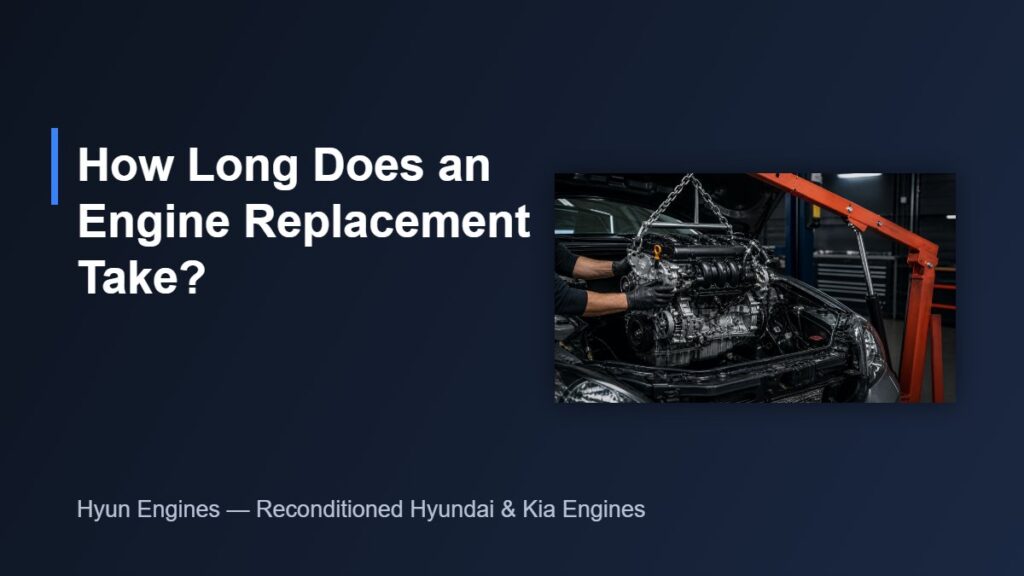
For most Hyundai and Kia models — an i30, Elantra, Tucson, Sportage or Sorento — the labour itself runs somewhere between 10 and 15 hours. That covers disconnecting and removing the old engine, transferring ancillaries, installing the replacement, refilling fluids and initial start-up checks. Spread across workshop scheduling, that’s the 2 to 3 day window we quote most customers for a complete engine supply and fit.
Transverse four-cylinder engines like Hyundai and Kia’s are relatively efficient to remove and refit compared with larger or more exotic layouts, but there is no shortcut around doing it methodically: rushed engine installations are where leaks, wiring faults and cooling problems come from.
What does the full timeline look like, start to finish?
The workshop days are only part of the story. Here’s the realistic sequence from the moment your engine fails to picking the car up:
| Stage | Typical time | What happens |
|---|---|---|
| Diagnosis | Half a day to 1 day | Confirming the engine actually needs replacement, not a cheaper repair |
| Sourcing the engine | Same day to a few days | Matching engine code and year; in-stock engines ship immediately |
| Removal and installation | 2–3 days | Old engine out, ancillaries transferred, reconditioned engine in |
| Testing and quality checks | Half a day | Fluids, leak checks, road test, fault-code scan |
| Pickup | — | Run-in advice and warranty paperwork handed over |
Put together, a typical job runs about a week door to door — and considerably less when the diagnosis is clear-cut and the engine is in stock.
What can slow an engine replacement down?
Three things account for almost every delayed job. First, parts availability: if your exact engine variant has to be sourced or reconditioned to order, that adds days. This is where choosing a supplier with stock on the shelf matters — our engine range covers the common Hyundai and Kia codes, from the G4KJ for Kia Sportage to Elantra and i30 units.
Second, the condition of ancillary components. The replacement engine reuses parts from your old one — manifolds, sensors, mounts, pulleys — and if the failure that killed your engine also cooked the radiator, contaminated the cooling system or damaged the wiring, those items need attention before the new engine can safely go in. Skipping them is how a replacement engine gets destroyed by the same problem that killed the first one.
Third, diagnosis. A knocking noise doesn’t automatically mean the whole engine is finished, and a proper assessment before ordering parts avoids both wasted money and wasted days. Sometimes the right answer is a repair or a rebuild rather than a full replacement — our engine rebuild service exists for exactly those cases.
Can anything make it faster?
Yes — mostly decisions made before the car reaches the hoist. Booking ahead so the workshop can schedule the job as one continuous block, confirming the engine code from your VIN so the right engine is reserved before the car arrives, and approving related work (mounts, timing components, coolant hoses) up front rather than mid-job all compress the timeline. When the engine is in stock and the car arrives on a booked day, 2 to 3 days in the workshop is a realistic promise, not a best case.
Is a fast engine swap a good sign or a bad one?
Speed is only worth having when the checks still happen. A same-day engine swap that skips cooling system flushing, oil pickup inspection and a proper road test is a false economy. Every engine that leaves our workshop has been tested before sale and checked after installation, because the 12-month warranty we put on every engine means we carry the risk if corners get cut. Wherever you have the work done, ask what testing is included — the answer tells you a lot.
Need an engine replaced without the guesswork? Hyun Engines supplies reconditioned, tested Hyundai and Kia engines with a 12-month warranty and fits them at our Dandenong workshop, typically within 2 to 3 days. Call (03) 9630 0960 (Mon–Fri 9am–5pm) or contact us online with your rego or VIN, and we’ll confirm the right engine, availability and a booking date — 8 Hammond Rd, Dandenong VIC 3175.
Frequently Asked Questions
How many hours of labour is an engine replacement?
Most Hyundai and Kia models need roughly 10 to 15 hours of labour for removal and installation. Spread across workshop scheduling, testing and checks, that translates to about 2 to 3 days in the workshop.
Can an engine be replaced in one day?
Technically possible on some vehicles, but it leaves no time for proper cooling system checks, leak testing and a road test. We’d rather return the car a day later and know the replacement engine is protected.
Do I need to book before bringing the car in?
Booking ahead is strongly recommended. It lets us confirm the correct engine from your VIN, reserve stock and schedule the job as one continuous block — which is how the 2 to 3 day turnaround is achieved.
What should I do while my old engine is still running but failing?
Minimise driving, keep the oil topped up and get the car assessed promptly. Continuing to drive a failing engine can damage components the replacement engine needs to reuse, which adds cost and days to the job.