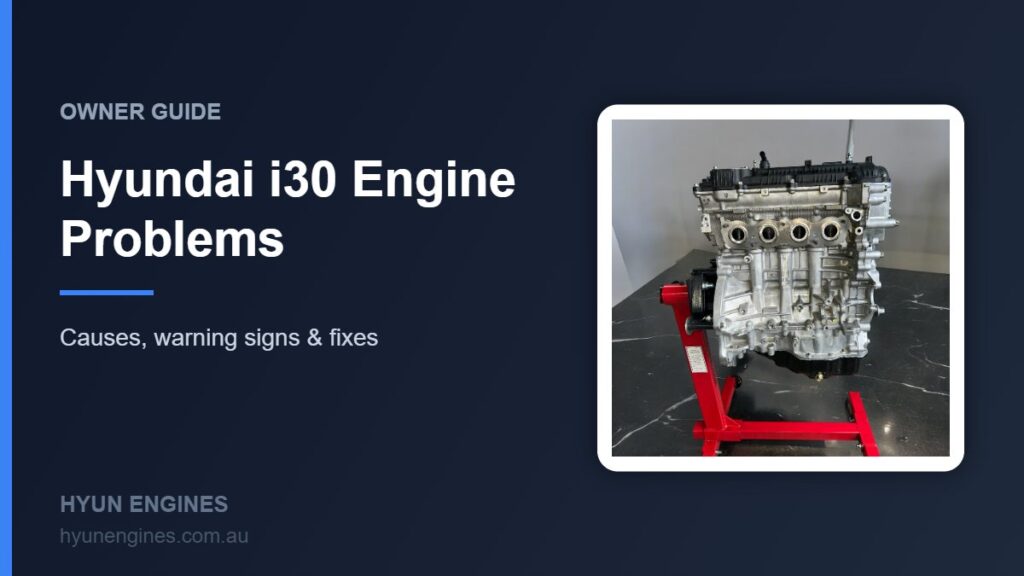
The short answer: most Hyundai i30 engine problems reported in Australia involve the 1.8-litre Nu engine (G4NB, 2012–2016) and the 2.0-litre Nu GDI (G4NC, 2017 onwards), with excessive oil consumption the most commonly reported complaint, followed by intake carbon buildup on the direct-injection engines and timing chain wear at higher kilometres. The earlier 1.6 MPI and well-serviced examples are generally far less troublesome.
Common Hyundai i30 engine problems
Excessive oil consumption
This is the complaint Australian i30 owners raise most often, particularly on the 1.8-litre G4NB fitted to the GD-series i30 (2012–2016) and the 2.0-litre G4NC in the PD series (2017 onwards). The engine gradually burns oil between services, and because many owners never check the dipstick between oil changes, the first sign is often a rattle or knock from an engine already running low. In the more severe commonly reported cases, cars have needed a litre or more of oil every 1,000–1,500 km. Left unchecked, low oil leads to bearing wear and, eventually, complete engine failure.
Carbon buildup on direct-injection (GDI) engines
The 1.6 GDI (G4FD), 2.0 GDI (G4NC) and 1.6 T-GDi (G4FJ) all spray fuel directly into the cylinder rather than onto the back of the intake valves. Without petrol washing over them, the valves slowly coat themselves in hard carbon deposits. Symptoms build gradually: rough cold idle, hesitation under throttle, poor fuel economy and occasional misfire codes. Carbon that migrates into the piston ring grooves can also stick the oil-control rings, which is one of the mechanisms behind the oil consumption problem above.
Timing chain stretch and rattle
All of these engines use a timing chain rather than a belt. On higher-kilometre G4NB and G4NC engines, chain stretch and tensioner wear are commonly reported, usually announced by a rattle on cold start that fades as oil pressure comes up. A stretched chain can eventually skip teeth and put the valve timing out, so a persistent cold-start rattle is worth investigating early.
Bearing wear and engine knock
Oil starvation from the consumption issue, stretched service intervals or low-quality oil can wear the connecting rod bearings. A deep knock that rises with engine speed is the classic symptom. If you can hear it, keep driving to a minimum — we cover why in our guide on whether you can drive with a knocking engine.
Turbo issues on the 1.6 T-GDi (i30 SR and N Line)
The turbocharged G4FJ in the i30 SR and later N Line is a strong performer, but a few patterns are commonly reported as these cars age. Oil weeping around the turbocharger frequently turns out to be the turbo oil feed line rather than the turbo itself — a far cheaper fix, and worth ruling out before anyone quotes a replacement turbo. Some engines also develop the same oil consumption habit as the rest of the GDI family, and timing chain tensioners can need attention at higher kilometres. Because the turbo works the oil harder, shortened oil change intervals matter even more on this engine than on the naturally aspirated ones.
Injector tick and fuel pump noise on GDI engines
Owners of the 1.6 GDI and 2.0 GDI often report a ticking noise from the top of the engine, especially when cold. In most cases this is simply the high-pressure fuel injection system doing its job — GDI injectors and pumps operate at very high pressures and are audibly clicky by design. A tick that fades as the engine warms is usually normal; a tick accompanied by misfires, rough running or a check engine light points to fouled injectors and deserves proper diagnosis.
Fuel system recalls (Australian market)
Two official Australian recalls are worth knowing about, both fuel-related rather than internal engine faults. Recall REC-006422 covers 18,634 i30 (PD) hatchbacks built in 2020–2021 for a fuel pump impeller that can deform and stall the engine, and REC-006573 covers 2017–2022 i30 N models for a high-pressure fuel pump defect that can also cause stalling. Both are fixed free of charge by Hyundai dealers — check your VIN at vehiclerecalls.gov.au. For the wider picture across the range, see our summary of Hyundai and Kia engine recalls in Australia.
Which i30 engines tend to have trouble?
Australian-delivered i30s used five main petrol engines. The table below maps each engine code to the models it powered and the issues most commonly reported for it.
| Engine code | Fitted to | Years (AU) | Known issues |
|---|---|---|---|
| G4FC 1.6 MPI | i30 FD / early GD (base petrol) | 2007–2014 | Generally robust; port injection avoids carbon buildup. Age-related leaks and cooling wear at high km. |
| G4FD 1.6 GDI | i30 GD (1.6 petrol variants) | 2012–2016 | Intake valve carbon buildup, injector fouling, high-pressure fuel pump tick (often normal but worth checking). |
| G4NB 1.8 Nu MPI | i30 GD Active, Elite, Premium | 2012–2016 | Oil consumption, cylinder bore wear, timing chain stretch, rod bearing wear if run low on oil. |
| G4NC 2.0 Nu GDI | i30 PD Active, Elite, Premium, N Line body | 2017 onwards | Oil consumption from sticking oil-control rings, carbon buildup, timing chain rattle at high km. |
| G4FJ 1.6 T-GDi | i30 SR / N Line (turbo) | 2016 onwards | Carbon buildup, oil consumption in some engines, turbo oil feed line leaks, tensioner wear at high km. |
Frequencies here are as commonly reported by owners and workshops — plenty of well-maintained examples of every engine above reach high kilometres without drama, a point we expand on in our look at Hyundai engine reliability.
Warning signs you should not ignore
- Oil level dropping between services. Check the dipstick monthly. Needing a top-up of more than about a litre every 1,500 km is outside what most workshops consider acceptable.
- Rattle on cold start. A few seconds of chain rattle that becomes consistent or louder points to a stretched timing chain or tired tensioner.
- Knocking under load. A deep, rhythmic knock that rises with revs suggests bearing wear — stop driving and have it inspected.
- Blue-grey exhaust smoke on start-up or under acceleration, which usually means oil is being burnt.
- Rough idle, hesitation or misfires on GDI engines, the classic signature of intake valve carbon buildup or fouled injectors.
- Oil pressure or check engine lights. An oil pressure warning at idle is an emergency — switch off as soon as it is safe.
The common thread is that every one of these symptoms is dramatically cheaper to deal with early. An i30 that gets a carbon clean and fresh rings at the first sign of oil use might cost a few thousand dollars to put right; the same car driven until it knocks generally needs a complete engine. Regular dipstick checks are the single cheapest piece of insurance an i30 owner has.
Why these engine problems happen
Three threads run through almost every i30 engine complaint. First, direct injection: it improves economy and power but leaves the intake valves dry, so carbon accumulates, and blow-by carried through the PCV system deposits carbon in the piston ring grooves where it sticks the oil-control rings. Second, oil control: once those rings stick, or bores wear oval on the 1.8, oil gets past the pistons and is burnt, and consumption accelerates the longer it goes unaddressed. Third, service history: these engines run long factory service intervals, and oil that stays in too long sludges, starves the chain tensioner and accelerates every wear process above. Australian conditions do not help — short urban trips never get the oil hot enough to burn off contaminants, and hot-climate stop-start driving works the oil harder than the lab schedule assumes. None of this makes the i30 a bad car; it makes the difference between a neglected engine and a cared-for one unusually large.
Repair or replace?
The right call depends on how far the damage has gone, the car’s overall condition and how long you plan to keep it. A tidy i30 with good paint, interior and history is usually worth saving — the engine is the expensive part, and the rest of the car can easily have another decade in it. All figures below are indicative Australian ranges — get a written quote for your specific car.
- Carbon cleaning (walnut blasting or chemical): roughly $400–$900. Worthwhile on a GDI engine that idles rough but is otherwise healthy.
- Timing chain and tensioner replacement: roughly $1,200–$2,500 depending on engine and access. Sensible if caught before the chain skips.
- Piston ring or engine rebuild: often $4,000–$7,000 once the head, machining and labour are counted — see our breakdown of engine reconditioning costs in Australia.
- Reconditioned engine, supplied and fitted: commonly $4,500–$7,500 all-up depending on the engine and what ancillaries carry over.
Once an engine is knocking, has scored bores or has been run low on oil, a reconditioned replacement is usually more economical than rebuilding the damaged unit, and you get a fully machined, tested engine rather than a patch repair. Every reconditioned engine we supply is covered by a 12-month warranty. Whichever way you go, have the diagnosis confirmed by a qualified mechanic before committing — a compression and leak-down test is cheap insurance against replacing an engine that only needed a carbon clean.
Related reconditioned engines
We recondition and supply the exact engines discussed above from our Melbourne workshop, with delivery Australia-wide:
- Reconditioned Hyundai i30 G4NB 1.8 engine (2012–2016 GD) — the engine most affected by oil consumption complaints.
- Reconditioned Hyundai i30 G4NC 2.0 engine (2017 onwards PD) — rebuilt with new rings and bearings to address the known oil-control weaknesses.
- Reconditioned Hyundai i30 SR / N Line G4FJ 1.6 turbo engine — for the turbocharged models.
Frequently Asked Questions
Which Hyundai i30 engine should I avoid?
No i30 engine is a guaranteed failure, but the 1.8 G4NB (2012–2016) attracts the most oil consumption complaints in Australia, with the 2.0 G4NC next. A car with full service history and a stable oil level between services is a far better bet than any particular engine code with unknown history.
Is the Hyundai i30 oil consumption problem fixable?
Yes. Mild cases sometimes respond to more frequent oil changes and piston-cleaning treatments, moderate cases need new piston rings, and worn bores need machining. Once bores are scored or bearings damaged, a reconditioned engine is usually the more economical and durable fix than rebuilding the original.
How long does an i30 engine replacement take?
With the reconditioned engine on hand, most workshops complete an i30 engine swap in two to four working days, including transferring ancillaries and road testing. Freight to your mechanic adds a few days if you are outside Melbourne. Our guide on how long engine replacement takes covers the full timeline.
Does the i30 have a timing belt or chain?
All Australian-market petrol i30 engines covered here — G4FC, G4FD, G4NB, G4NC and G4FJ — use a timing chain, not a belt. Chains are designed to last the life of the engine but do stretch at high kilometres, especially with extended oil change intervals, so investigate any persistent cold-start rattle.
Was there an Australian recall for i30 engine problems?
The notable Australian recalls are fuel-system related: REC-006422 for the 2020–2021 i30 fuel pump impeller and REC-006573 for the 2017–2022 i30 N high-pressure fuel pump, both for stalling risk. The oil consumption and carbon issues have not been the subject of an Australian recall. Check your VIN at vehiclerecalls.gov.au.