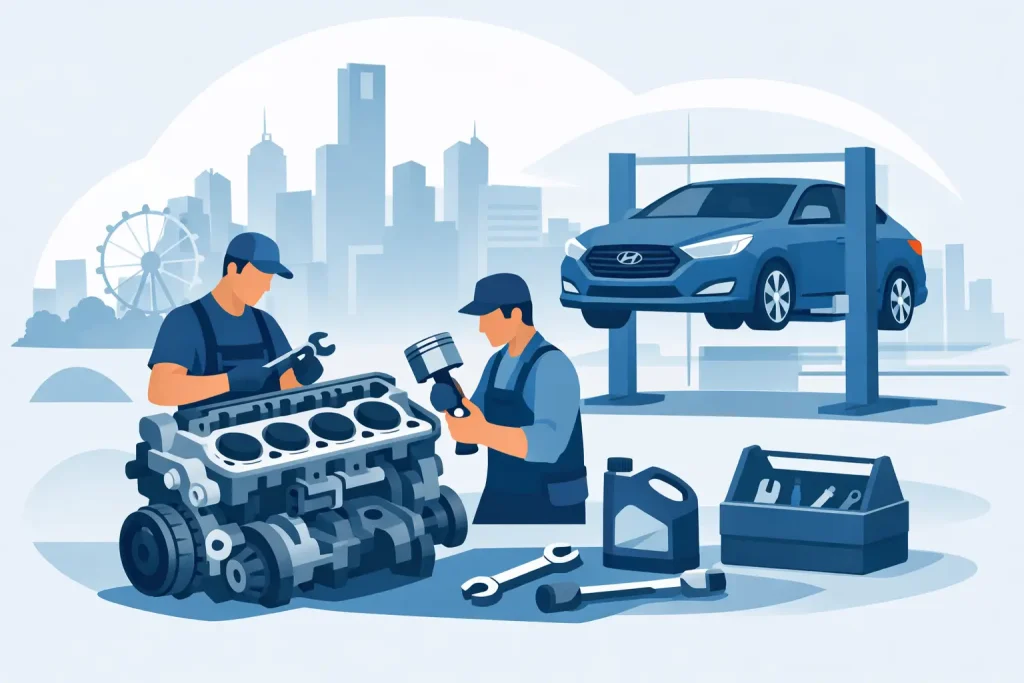
When your Hyundai starts knocking, burning oil, overheating or losing power, the question usually comes fast – rebuild it, replace it, or move it on. For many owners, a Hyundai engine rebuild Melbourne workshop can carry out is the most sensible path, but only when the fault has been diagnosed properly and the rebuild is done by people who know these engines inside out.
That matters more than most people realise. A Hyundai petrol or diesel engine can fail for very different reasons depending on the model, service history and how the vehicle has been used. An iLoad doing delivery work has different stresses to an i30 used for school runs. A Tucson with timing issues needs a different approach to a diesel van with bottom-end wear. Clear advice at the start saves money and avoids doing the same job twice.
When a Hyundai engine rebuild in Melbourne makes sense
A rebuild is not automatically the right answer every time an engine has a major problem. Sometimes a replacement engine is the better option. Sometimes the damage is limited to one system and does not call for a full strip-down. The right decision depends on the extent of wear, the availability of parts, the value of the vehicle and how long you plan to keep it.
In general, a rebuild makes the most sense when the core engine is still worth saving. That could mean worn piston rings, bearing damage, oil consumption, compression loss, head gasket failure after overheating, or internal noise that points to wear through the rotating assembly or valvetrain. If the block, crank and head are serviceable, rebuilding can restore reliability without the uncertainty that sometimes comes with an unknown used engine.
For owners who know their vehicle, have looked after it, and want to keep it on the road, rebuilding can be a practical long-term fix. For fleet operators and tradies, it can also make sense where downtime, fitment quality and after-sales support matter just as much as the upfront figure.
Signs your Hyundai engine may need rebuilding
Most engines do not fail without warning. The problem is that early signs are often ignored until the repair bill gets bigger. If your Hyundai has persistent knocking, rattling on startup, heavy smoke, ongoing oil loss, coolant contamination, repeated overheating or a clear drop in compression, it needs proper inspection sooner rather than later.
Timing-related problems are another big one. On some Hyundai and Kia engines, timing chain wear or failure can lead to serious internal damage if left too long. Diesel engines can also develop turbo-related issues that contaminate the intake and affect overall engine condition. Not every noise means a rebuild, but every unexplained noise should be checked by a specialist workshop.
A warning light on its own does not tell the whole story. Neither does a quick scan from a general repairer. A real diagnosis usually involves mechanical testing, fault tracing and, in some cases, partial disassembly to confirm what has failed and how far the damage has spread.
What happens during a Hyundai engine rebuild
A proper rebuild is not just a matter of replacing a few gaskets and sending the car back out. The engine is removed, stripped and assessed component by component. The aim is to identify not only what failed, but why it failed.
That process usually starts with inspection of the block, cylinder head, pistons, crankshaft, bearings, oil pump, timing components and valvetrain. Machining may be required depending on wear and damage. Parts that are out of tolerance need to be replaced. Surfaces need to be measured, not guessed. On modern Hyundai engines, detail matters because small errors in timing, oil control or clearances can turn into a very expensive comeback.
Reassembly should include quality replacement parts, correct torque procedures and attention to related systems that may have contributed to the failure. That can include cooling components, injectors, turbo hardware, timing gear, sensors and ancillary items. If those issues are ignored, even a freshly rebuilt engine can be put at risk.
Testing is just as important as rebuilding. Before installation and handover, the engine should be checked carefully so the customer is not left wondering whether the original problem has actually been solved.
Rebuild or replacement – which is better?
This is where honesty matters. Some engines are better rebuilt. Others are better replaced with a tested reconditioned, used or new unit, depending on budget and availability.
A rebuild can be the better option if you want to retain the original engine, the damage is repairable, and the workshop has the right Hyundai and Kia experience. It also gives more control over what is being renewed. You know what has been measured, machined and replaced.
A replacement engine can be the better path if your original unit has severe block damage, has thrown a rod, suffered major overheating damage or would cost too much to machine back to standard. In those cases, supply and fit of a tested engine may be quicker and more economical.
There is no one-size-fits-all answer. The best workshops will explain the trade-off clearly. A cheaper option is not always cheaper long term if it adds risk, and the most expensive option is not always necessary if the original engine can be rebuilt properly.
What affects Hyundai engine rebuild costs in Melbourne?
Owners usually ask about price first, which is understandable. Engine rebuild costs vary because no two failures are exactly the same. The final figure depends on the engine type, extent of internal damage, parts required, machining needed and whether related systems also need attention.
A diesel commercial vehicle that has done heavy kilometres will often require a different level of work to a smaller petrol passenger car. If the cylinder head is cracked, the crank is damaged, injectors need work or the turbo has contributed to contamination, the scope can expand quickly. Labour also reflects the complexity of removing and refitting the engine in different Hyundai models.
The important thing is not chasing the lowest quote. It is understanding what the quote includes. Diagnosis, engine removal, strip-down, machining, replacement parts, reassembly, installation, fluids, testing and warranty support should all be clear. A vague estimate can end up costing more once the job is underway.
Why specialist Hyundai experience matters
Not every workshop sees Hyundai and Kia engine problems every day. That difference shows up in diagnosis, parts selection and repair quality.
A specialist workshop is more likely to recognise common failure patterns across models such as the iLoad, Tucson, i30 and related Kia platforms. That can speed up diagnosis and reduce unnecessary work. It also means the mechanic is more likely to know what should be checked while the engine is apart, rather than only fixing the obvious damage.
For customers, that usually means fewer surprises and clearer answers. If your vehicle is used for family transport, work or fleet duties, confidence in the repair matters as much as the repair itself. Hyun Engines, operating from Dandenong as part of Grand Autoworks, focuses specifically on Hyundai and Kia engines, which is exactly the kind of specialisation many owners want when the job is this serious.
Questions to ask before approving the job
Before you commit to a rebuild, ask what has actually failed and how that was confirmed. Ask whether the engine is a good candidate for rebuilding or whether replacement would be better value. Ask what parts are being replaced, what machining is required, and whether the quote includes removal, refit, fluids, testing and warranty.
It is also worth asking what caused the original failure. That answer tells you a lot about the quality of the diagnosis. If the workshop cannot explain why the engine failed, there is a risk the underlying cause has not been addressed.
Turnaround time matters too, especially if the vehicle is your daily transport or work van. A realistic timeframe is better than a rushed promise. Good workshops will be upfront if they are waiting on machining, parts supply or extra inspection results.
The value of doing it properly once
An engine rebuild is a major job, but it does not have to be guesswork. The best outcomes come from a clear diagnosis, the right repair path and a workshop that understands Hyundai engines beyond general mechanical work.
If your vehicle is showing serious signs of engine trouble, acting early gives you more options. Sometimes that means a rebuild. Sometimes it means a tested replacement. Either way, clear advice. Straight answers. No confusion. That is what gets you back on the road with confidence, rather than paying twice for a problem that should have been fixed properly the first time.
Frequently Asked Questions
Where can I get a Hyundai engine rebuilt or replaced in Melbourne?
At our Dandenong workshop, where we supply and fit reconditioned Hyundai engines and can advise whether a rebuild or replacement suits your situation.
Is a rebuild or a reconditioned replacement better?
A reconditioned replacement is often faster because the tested unit is ready to fit, and it comes with a 12-month warranty; a rebuild can suit minor damage.
How much does a Hyundai engine rebuild cost?
It varies with parts and labour and can approach the price of a tested reconditioned engine, which many owners choose instead.
Do you offer fitting in Melbourne?
Yes, fitting at our Dandenong workshop typically takes 2-3 days, with engines also shipped Australia-wide.