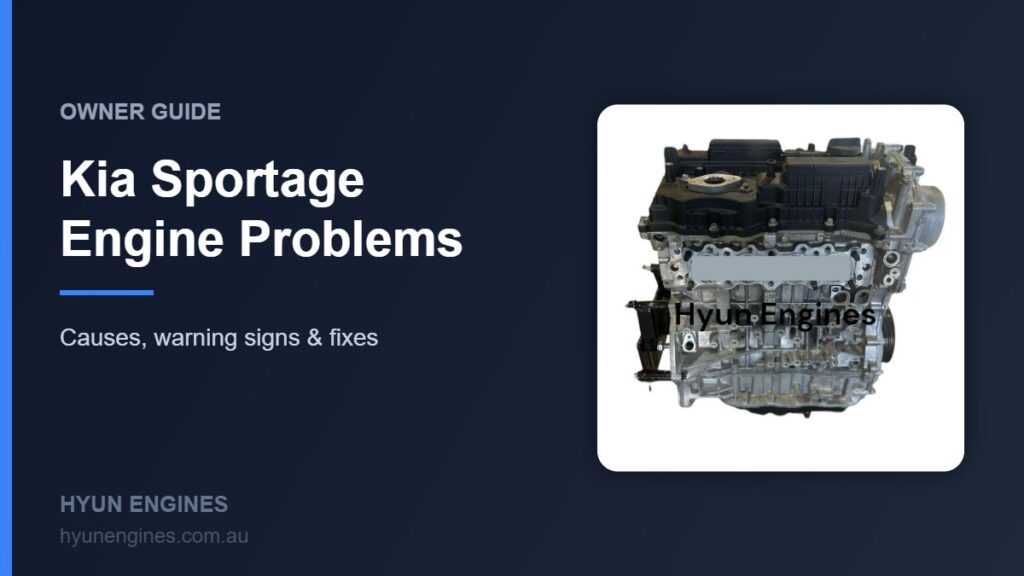
The short answer: the most serious Kia Sportage engine problems reported in Australia involve the Theta II petrol engines — the 2.0 and 2.4 units fitted between 2010 and 2021. Connecting rod bearing wear, cylinder scuffing and heavy oil consumption are commonly reported, and a worn bearing can seize the engine with little warning, so any knocking noise needs immediate attention.
The Sportage has been one of Australia’s most popular SUVs for over a decade, and most examples give long, trouble-free service. But two engine families — the Theta II and, to a lesser degree, the Nu — have well-documented weaknesses that every owner and used-car buyer should understand. This guide covers the SL (2010–2015) and QL (2015–2021) generations; you can find our full model coverage on our Kia engines hub.
Common Kia Sportage engine problems
Connecting rod bearing wear and engine seizure (Theta II)
This is the headline problem, and the reason Hyundai and Kia’s Theta II engines have attracted recalls, service campaigns and class actions around the world. The connecting rod bearings — the plain bearings that let the conrods spin on the crankshaft — can wear prematurely. Debris left in the crankshaft oil passages during manufacturing has been identified as one cause, restricting oil flow to the bearings. A worn bearing first announces itself as a deep knock from the bottom of the engine; left alone, the bearing can seize or the conrod can break and punch through the block, which destroys the engine instantly and, in a small number of commonly reported cases overseas, has caused engine bay fires from escaping oil.
Cylinder bore scuffing and piston ring problems (G4KD)
The 2.0-litre G4KD in the SL Sportage is commonly reported for cylinder bore scuffing, often appearing around the 100,000 km mark. Cracked or poorly sealing piston rings score the cylinder walls, compression drops and oil consumption climbs. In Australia, this exact defect — piston ring cracking leading to scuffed bores — is one of the failure modes described in the Australian class action covering Theta II engines, and affected engines have needed replacement rather than repair.
Excessive oil consumption
Both the Theta II engines and the 2.0-litre Nu petrol in the QL Sportage are commonly reported for burning oil between services. Once ring sealing deteriorates, consumption of a litre or more per 1,000–1,500 km is not unusual in the worse cases. The danger is circular: burning oil lowers the level, a low level starves the already vulnerable rod bearings, and bearing failure follows. Many Sportage engines that ultimately seized gave their first warning as nothing more than a low dipstick reading.
Carbon buildup on the 2.4 GDI
The G4KJ 2.4 in the QL GT-Line uses direct injection, so fuel never washes over the intake valves. Hard carbon deposits accumulate over time, producing rough cold idle, hesitation and occasional misfire codes. It is a gradual, manageable issue rather than a catastrophic one, but it compounds the oil-control problems above when carbon migrates into the piston ring grooves.
Recalls, service campaigns and the Australian class action
Kia has run software-based knock sensor detection campaigns on Theta II vehicles in overseas markets, designed to detect early bearing wear and put the car into a protective limp mode before the engine fails. In Australia, a class action was filed in 2023 covering certain Hyundai and Kia vehicles fitted with Theta II MPI and GDI engines (engine codes beginning G4KD, G4KE, G4KH, G4KJ and G4KL), among others, alleging the engines are defective. Whether your specific vehicle has outstanding recall or service campaign work is a VIN-level question — check with Kia Australia using your VIN, and see our summary of Hyundai and Kia engine recalls in Australia for the wider picture.
Which Kia Sportage engines tend to have trouble?
Australian-delivered Sportages of this era used four main engines. The table below maps each code to the models it powered and the issues most commonly reported for it.
| Engine code | Fitted to | Years (AU) | Known issues |
|---|---|---|---|
| G4KD 2.0 Theta II MPI | Sportage SL (2.0 petrol) | 2010–2015 | Cylinder bore scuffing, piston ring cracking, oil consumption, rod bearing wear. Covered by the Australian Theta II class action. |
| G4KE 2.4 Theta II MPI | Sportage SL (2.4 petrol variants) | 2010–2015 | Same Theta II family weaknesses: rod bearing wear, oil consumption, knocking at higher kilometres. |
| G4KJ 2.4 Theta II GDI | Sportage QL GT-Line / Platinum | 2015–2021 | Rod bearing wear and potential seizure, oil consumption, intake valve carbon buildup from direct injection. |
| G4NC 2.0 Nu petrol | Sportage QL (2.0 petrol) | 2015–2021 | Ticking and piston slap when cold, oil consumption from ring sealing, generally less severe than the Theta II. |
The 2.0 turbo-diesel offered across both generations is a different engine family again and is generally regarded as durable, with its commonly reported issues (DPF and injector wear at high kilometres) being fuel-system rather than internal. Frequencies above are as commonly reported by owners and workshops — plenty of well-serviced Sportages of every variant reach high kilometres without drama.
Warning signs you should not ignore
- Knocking or deep rattling from the engine. On a Theta II, a rhythmic knock that rises with engine speed is the classic rod bearing symptom. Stop driving and have it inspected — our guide on whether you can drive with a knocking engine explains why every kilometre matters.
- Oil level dropping between services. Check the dipstick monthly. More than about a litre every 1,500 km is outside what most workshops consider acceptable, and on these engines a low level directly threatens the bearings.
- Check engine light or a sudden reduction in power. On vehicles with knock-detection software, limp mode may be the car actively protecting a failing bearing — do not clear the light and drive on.
- Blue-grey exhaust smoke on start-up or under acceleration, which points to oil being burnt past worn rings.
- Metallic particles in the oil at a service, or glitter on the dipstick — a strong indicator of bearing material wearing away.
- Rough cold idle and hesitation on the 2.4 GDI, the usual signature of intake valve carbon buildup.
The common thread: every one of these symptoms is far cheaper to act on early. A Sportage caught at the low-oil stage might need rings and bearings; the same car driven until it knocks almost always needs a complete engine. If you are inspecting a used SL or QL, start it stone cold, listen for knocks and ticks, check the dipstick, and ask for invoices showing regular oil changes — on a Theta II, service history is worth more than kilometres travelled.
Why these engine problems happen
Three factors sit behind most Sportage engine failures. First, manufacturing debris: machining swarf left in the crankshaft oil passages of some Theta II engines restricts oil supply to the rod bearings, so the bearings run partially starved even in a well-serviced car. Second, oil control: piston ring sealing on both the G4KD and the Nu engines deteriorates with age, oil is burnt, and the falling oil level compounds the bearing-starvation problem. Third, heat and service intervals: direct-injection engines run hot, work their oil hard, and the long factory service intervals leave degraded oil in the engine at exactly the time the bearings need it most. Australian conditions — hot climates, stop-start urban running and long highway distances — amplify all three. None of this makes the Sportage a bad vehicle, but it does make frequent oil changes and regular dipstick checks unusually important on these engines.
Repair or replace?
The right call depends on how far the damage has gone. All figures below are indicative Australian ranges — get a written quote for your specific vehicle from a qualified mechanic.
- Carbon cleaning (2.4 GDI): roughly $400–$900. Worthwhile on an engine that idles rough but is otherwise healthy.
- Piston rings and bearings, engine in situ or out: often $4,000–$7,000 once machining and labour are counted — and only viable if the crankshaft and bores are still serviceable. Our breakdown of engine reconditioning costs in Australia covers what drives the price.
- Reconditioned engine, supplied and fitted: commonly $5,000–$8,500 all-up for a Sportage, depending on the engine and which ancillaries carry over.
- New long block from Kia: typically the most expensive route, often well beyond the reconditioned option once fitted.
Once a Theta II is knocking, has scored bores or has run low on oil, a reconditioned replacement is usually more economical than rebuilding the damaged unit — bearing debris circulates through the whole engine, so a patch repair on a knocked engine rarely lasts. A properly reconditioned engine is machined, fitted with new bearings and rings, and tested before delivery. Every reconditioned engine we supply is covered by a 12-month warranty.
Related reconditioned engines
We recondition and supply the exact Sportage engines discussed above from our Melbourne workshop, with delivery Australia-wide:
- Reconditioned Kia Sportage G4KJ 2.4 engine (2015–2021 QL) — the Theta II GDI, rebuilt with new rod bearings to address the known failure mode.
- Reconditioned Kia Sportage G4NC 2.0 engine — for the 2.0 petrol QL, rebuilt with new rings and bearings.
Frequently Asked Questions
Is my Kia Sportage part of a Theta II recall in Australia?
Recall and service campaign coverage is determined at the VIN level, and campaigns have differed between markets, so do not rely on overseas recall lists. Check with Kia Australia using your VIN, or search the federal government’s vehicle recalls website. If campaign software or inspection work is outstanding, Kia dealers complete it free of charge.
What does a Kia Sportage engine replacement cost in Australia?
Indicatively, a reconditioned Sportage engine supplied and fitted commonly lands between $5,000 and $8,500 depending on the engine code, freight and which ancillaries transfer across. A new long block from the dealer costs considerably more. Always get an itemised written quote, as labour varies between the 2.0 and 2.4 engines.
Can I keep driving my Sportage if the engine is knocking?
No — on a Theta II engine a knock almost always means rod bearing wear, and continued driving can turn a repairable situation into a seized engine or a conrod through the block within a very short distance. Stop, have it towed if necessary, and get a diagnosis from a qualified mechanic before restarting it.
Which Kia Sportage engine is the most reliable?
The 2.0 turbo-diesel is generally regarded as the most durable engine of this era, with mainly fuel-system wear items at high kilometres. Among the petrols, the Nu 2.0 in the QL attracts fewer severe complaints than the Theta II units, though it still benefits from shortened oil change intervals and regular dipstick checks.
Is the Australian Theta II class action still open?
A class action covering certain Kia vehicles with Theta II MPI and GDI engines — codes beginning G4KD, G4KE, G4KH, G4KJ and G4KL — was filed in Australia in 2023. Eligibility and status change over time, so check the class action’s official website and confirm whether your VIN and purchase date fall within the claim group.