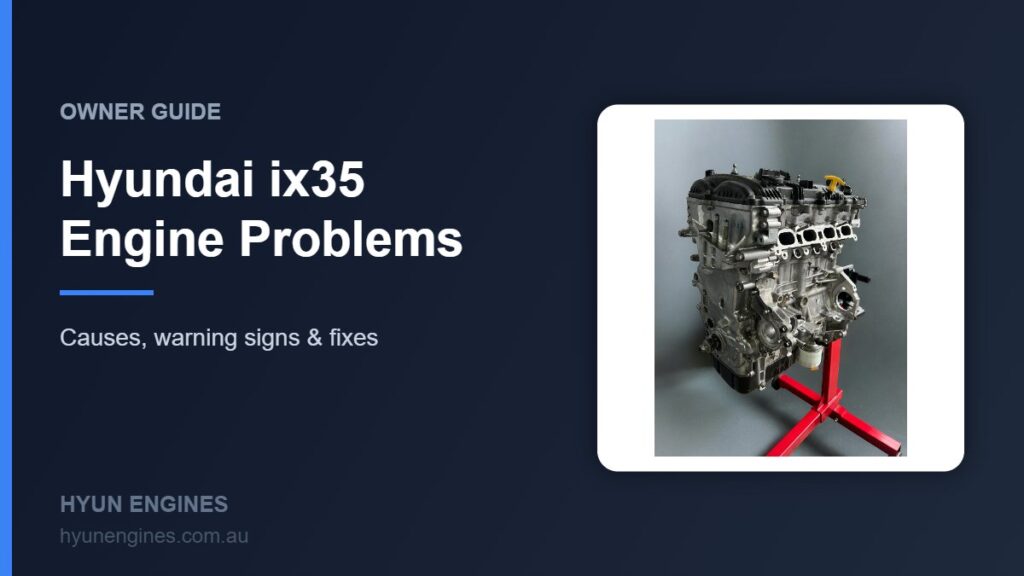
The short answer: The Hyundai ix35 (2010–2015) is a capable small SUV, but its petrol engines — the G4KD 2.0 and G4KE 2.4 Theta II, and the later G4NC 2.0 and G4KJ 2.4 GDI units — are commonly reported to suffer oil consumption, cylinder scoring, timing chain stretch and, on direct-injection versions, carbon buildup. Caught early, many issues are repairable; serious bottom-end wear usually calls for a reconditioned engine.
Common Hyundai ix35 engine problems
The ix35 was sold in Australia from 2010 to 2015 before being renamed Tucson. Across Series I and Series II it used four petrol engines, three of them from the Theta II family that has attracted worldwide attention for premature engine wear. The problems below are the ones most commonly reported by Australian owners and workshops.
- Excessive oil consumption. The most commonly reported complaint on the G4KD 2.0 and G4KE 2.4. Cylinder wall scoring and worn piston rings let oil past into the combustion chamber, so the engine burns oil between services. Left unchecked, low oil accelerates wear on the bearings and can end in complete engine failure.
- Cylinder scoring and piston slap. A rattly, diesel-like knock on cold start that fades as the engine warms is commonly reported on the G4KD. It points to piston-to-bore clearance problems and scored cylinder walls — the root cause of the oil consumption above — and it generally worsens over time rather than fixing itself.
- Connecting rod bearing wear. The Theta II family is known globally for rod bearing failures. A deep, rhythmic metallic knock that rises with engine speed is the classic symptom. A failed rod bearing can seize the engine or put a rod through the block with little warning.
- Timing chain stretch. Commonly reported on higher-kilometre Theta II engines, often before 150,000 km where servicing has been patchy. Symptoms include a rattle from the front of the engine, a check engine light and camshaft correlation fault codes. A stretched chain that jumps teeth can bend valves.
- Intake valve carbon buildup (GDI engines). The Series II G4NC 2.0 and G4KJ 2.4 are direct-injection engines, so no petrol washes over the backs of the intake valves. Carbon accumulates on the valves and ports, causing rough idle, cold-start misfires, hesitation and gradually falling fuel economy.
- Oil and coolant leaks. Rocker cover gaskets, front timing cover seals and, less commonly, leaking water pumps show up on higher-kilometre cars. These are cheap to fix early but dangerous to ignore, because both low oil and overheating are killers for an already-stressed Theta II engine.
Which ix35 engines tend to have trouble?
Not every ix35 engine carries the same risk. The table below covers the petrol engines fitted to Australian-delivered cars. (The 2.0-litre R-series turbo-diesel was also offered and is a different engine family with different issues.)
| Engine code | Fitted to | Years | Known issues |
|---|---|---|---|
| G4KD 2.0 MPI (Theta II) | ix35 Series I Active and Elite 2WD | 2010–2013 | Cylinder scoring, piston slap, oil consumption, timing chain stretch |
| G4KE 2.4 MPI (Theta II) | ix35 Series I Elite and Highlander AWD | 2010–2013 | Oil consumption, rod bearing wear, timing chain stretch |
| G4NC 2.0 GDI (Nu) | ix35 Series II Active and SE 2WD | 2013–2015 | Intake valve carbon buildup, some oil consumption reports |
| G4KJ 2.4 GDI (Theta II) | ix35 Series II Elite and Highlander AWD | 2013–2015 | Rod bearing wear, oil consumption, carbon buildup |
The same engine families were carried over into the Tucson that replaced the ix35, which is why the two models share so many symptoms — we cover that model separately in our guide to Hyundai Tucson engine problems.
Warning signs you should not ignore
Theta II failures rarely come out of nowhere. Most engines give weeks or months of warning, and acting on the first symptom is often the difference between a moderate repair bill and a full engine replacement.
- Knocking or tapping that rises with revs. The signature of rod bearing wear. If you hear it, stop driving and have the car inspected — we explain why in our guide on whether you can drive with a knocking engine.
- Oil level dropping between services. If you are topping up more than about a litre between oil changes, the rings or bores are likely worn. Check the dipstick monthly on any Theta II engine.
- Blue smoke from the exhaust, especially at cold start or under acceleration — burning oil.
- Rattle on cold start from the front of the engine — possible timing chain stretch or piston slap.
- Rough idle, misfires or hesitation on the GDI engines — often carbon buildup, sometimes ignition coils or injectors.
- Oil pressure or check engine warning lights. Never drive on with an oil light illuminated; oil starvation can destroy a Theta II bottom end in minutes.
- Metallic glitter in the oil at service time — bearing material circulating through the engine. At this point the engine is on borrowed time.
If you are inspecting a used ix35 before purchase, the same list doubles as a checklist. Start the engine stone cold and listen for rattle in the first thirty seconds, check the dipstick for level and condition, look for blue smoke on a hard acceleration, and ask for service invoices — a Theta II with a documented history of on-time oil changes is a very different proposition from one without. A pre-purchase inspection by a qualified mechanic is cheap insurance on this platform.
Why these engine problems happen
The Theta II story is well documented. In overseas markets, Hyundai and Kia recalled millions of Theta II GDI vehicles because metal debris left over from factory machining of the crankshaft could restrict oil flow to the connecting rod bearings, causing premature wear, knocking and, in the worst cases, engine seizure. The Australian picture is narrower: local campaigns focused on certain 2.4 GDI vehicles, and the ix35’s MPI engines (G4KD and G4KE) were generally not included in an Australian recall. Coverage is always VIN-specific, so check with Hyundai Australia using your VIN — our summary of Hyundai and Kia engine recalls in Australia explains what the campaigns involved.
Beyond the manufacturing issue, several design and usage factors work against these engines. The G4KD’s piston and bore design is prone to scuffing, particularly when the engine runs hot or the oil is old; once the cylinder walls score, oil consumption begins and accelerates wear everywhere else. Direct injection on the G4NC and G4KJ means intake valves never get cleaned by fuel, so carbon builds steadily — a problem made worse by short urban trips. And long service intervals or cheap oil are especially punishing here: these engines depend on clean, full oil more than most. Australian summer heat, towing and stop-start commuting all raise the load further.
None of this makes every ix35 a time bomb. Plenty of well-serviced examples pass 250,000 km. It does mean maintenance history matters more for this engine family than for most.
Repair or replace?
The right call depends entirely on what has actually worn. Have a qualified mechanic confirm the diagnosis first — a compression and leak-down test, an oil pressure test and an inspection of the oil filter for metal will usually tell the story. Indicative Australian prices:
- Intake valve carbon cleaning (GDI engines): roughly $400–$900. Worth doing at the first sign of rough idle.
- Timing chain kit replacement: roughly $1,200–$2,500 depending on the workshop and what else is replaced while the front of the engine is apart.
- Reconditioning your existing engine: commonly $3,500–$7,000 for a Theta II rebuild once machining, parts and labour are counted — see our breakdown of engine reconditioning costs in Australia.
- Exchange reconditioned engine, supplied and fitted: commonly $4,500–$7,500 all up, and usually the faster option because the engine is already built.
As a rule of thumb: carbon, leaks and chains are worth repairing. Once there is confirmed cylinder scoring, heavy oil consumption or bearing knock, patch repairs rarely last — the wear is spread through the engine, and a properly reconditioned unit with machined bores, new pistons, rings and bearings is the more economical fix over any horizon longer than a year.
It is also worth weighing the repair against the car. A tidy ix35 with good history is still a genuinely useful SUV, and a reconditioned engine typically costs far less than changing over to a comparable newer vehicle once stamp duty, transfer and the unknowns of another used car are counted. Where the body, transmission and interior are sound, replacing the engine is usually the financially sensible path; where the car has rust, accident history or a tired transmission as well, it may not be. A frank conversation with your mechanic about the whole car — not just the engine — is worth having before any money is spent.
Related reconditioned engines
We stock fully reconditioned engines for every petrol ix35 variant, rebuilt with machined blocks, new bearings, rings and gaskets, and covered by a 12-month warranty. If you are not sure what a rebuild involves, our explainer on what a reconditioned engine is walks through the process.
- Hyundai ix35 G4KD 2.0L engine — Series I 2.0 petrol
- Hyundai ix35 G4KE 2.4L engine — Series I 2.4 petrol
- Hyundai ix35 G4KJ 2.4L GDI engine — Series II 2.4 petrol
- Hyundai ix35 G4NC 2.0L GDI engine — Series II 2.0 petrol
Frequently Asked Questions
Is the Hyundai ix35 the same as the Tucson?
Effectively, yes. The ix35 was the Australian and European name for the second-generation Tucson, and the name reverted to Tucson from 2015. The two share the same Theta II and Nu engine families, which is why they show the same patterns of oil consumption, bearing wear and carbon buildup.
Was the ix35 included in the Australian Theta II engine recall?
Australian Theta II campaigns centred on certain vehicles with the 2.4 GDI engine, and the ix35’s MPI engines were generally not recalled locally. Because coverage depends on the exact build, the only reliable answer is to check with Hyundai Australia using your VIN, or search the federal vehicle recalls database.
How many kilometres will an ix35 engine last?
A well-serviced ix35 petrol engine commonly reaches 200,000–250,000 km, and some go further. Poorly maintained examples can show cylinder scoring and heavy oil consumption from around 100,000–120,000 km. Regular oil changes with quality oil, and checking the dipstick monthly, make the single biggest difference to lifespan.
Can I keep driving my ix35 if the engine is knocking?
No — a knock that rises with engine speed usually means rod bearing wear, and continuing to drive risks sudden seizure, which can be dangerous in traffic and turns a repairable engine into scrap. Have the car towed or driven the shortest possible distance to a qualified mechanic for diagnosis.
What does a reconditioned ix35 engine cost?
As an indicative guide, a reconditioned Theta II or Nu engine for the ix35 typically costs a few thousand dollars supplied, with a fitted price commonly in the $4,500–$7,500 range depending on the variant and workshop rates. Contact us with your VIN for an exact quote on the correct engine.