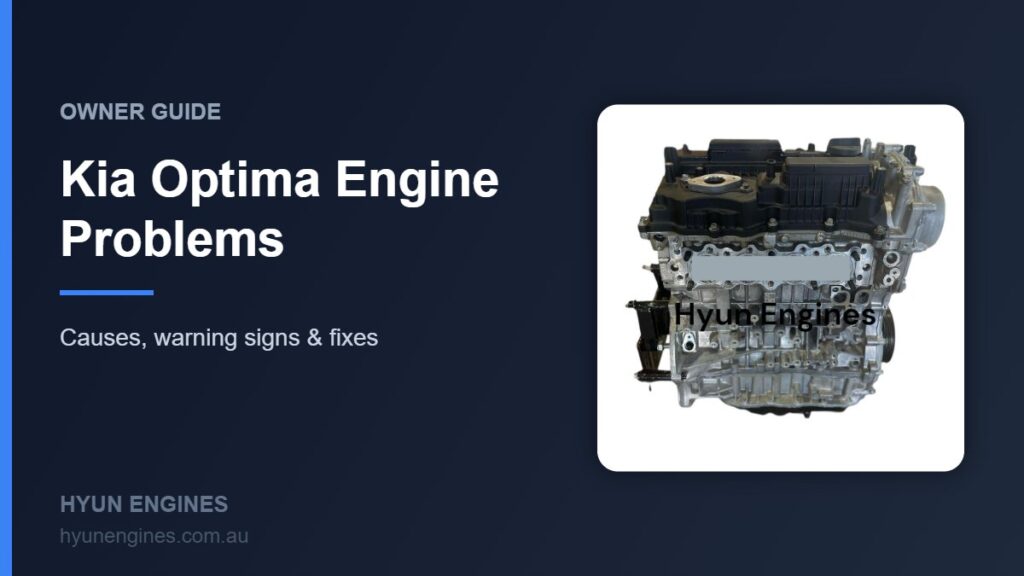
The short answer: The most serious Kia Optima engine problems affect the 2.4-litre Theta II petrol engines (G4KJ GDI and G4KE MPI), where manufacturing debris in the crankshaft oil passages can wear the connecting rod bearings and, in the worst cases, seize the engine. Excessive oil consumption and engine knock are the other commonly reported complaints in Australia.
Common Kia Optima engine problems
The Optima sold in Australia across the TF (2011–2015) and JF (2015–2020) generations is generally a well-equipped, comfortable sedan, but its Theta II engine family carries some of the best-documented engine problems in the modern Kia and Hyundai range. These are the issues Australian owners and mechanics report most often.
- Connecting rod bearing wear and engine seizure. This is the headline Theta II problem worldwide. Metal debris (swarf) left in the crankshaft oil passages during manufacturing can circulate through the oil system and score the rod bearings. Once a bearing wears, it produces a knocking or rattling noise from the bottom end and can eventually spin or seize, stopping the engine without warning. It is commonly reported on both the G4KJ 2.4 GDI and the related G4KE 2.4 MPI.
- Excessive oil consumption. Many higher-kilometre Theta II engines burn noticeably more oil between services than they should. Commonly reported causes include worn piston rings and cylinder bore wear. Low oil level accelerates bearing wear, so the two problems feed each other.
- Engine knock under load. A deep, rhythmic knock that rises with engine speed is the classic symptom of rod bearing wear. If you hear it, our guide on whether you can drive with a knocking engine explains why the safe answer is usually no.
- Sudden stalling or limp mode. Vehicles that have had Kia’s Knock Sensor Detection System (KSDS) software installed may drop into a reduced-power limp mode when the software detects bearing noise. It is a protection feature, not a fault in itself, but it means the engine needs inspection promptly.
- Carbon buildup on GDI engines. Because the G4KJ injects fuel directly into the cylinder, the backs of the intake valves miss out on the cleaning effect of fuel spray. Over time, carbon deposits can cause rough idle, hesitation and misfires, particularly on cars that do mostly short urban trips.
- Oil starvation damage from neglected servicing. The Theta II is less forgiving of missed oil changes than most engines. Because the bearings may already be dealing with circulating debris, old or low oil removes the last margin of protection, and commonly reported failures cluster around vehicles with patchy service records.
Which Kia Optima engines tend to have trouble?
Australian-delivered Optimas used three main petrol engines across the TF and JF generations. All belong to, or are closely related to, the Theta II family.
| Engine code | Fitted to | Years (approx.) | Known issues |
|---|---|---|---|
| G4KJ 2.4L Theta II GDI | Optima TF Si/Platinum; Optima JF Si/SLi (also used in Sorento and Grand Carnival) | 2011–2020 | Rod bearing wear and seizure, oil consumption, engine knock, intake valve carbon buildup |
| G4KE 2.4L Theta II MPI | Earlier Optima/Magentis; shared with Sportage and Sorento | 2006–2013 | Rod bearing wear (commonly reported), oil consumption at higher kilometres |
| G4KH 2.0L Theta II T-GDI | Optima GT (JF) | 2016–2020 | Oil consumption, heat stress from the turbocharger, bearing wear commonly reported overseas |
The naturally aspirated G4KJ is the volume engine in Australian Optimas and the one most associated with the Theta II bearing problem. You can browse the full range of Kia engines we stock, including Theta II units, in our Kia engines range.
Warning signs you should not ignore
Theta II bearing failure rarely happens without notice. The engine usually telegraphs the problem for hundreds or even thousands of kilometres first. Watch for:
- Knocking, ticking or rattling from the engine bay, especially a deep knock that speeds up with revs. This is the single most important warning sign.
- The oil pressure or check engine light flickering, particularly at idle when the engine is hot.
- Oil level dropping between services. If you are topping up more than about a litre between oil changes, have the engine assessed.
- Metallic glitter in the engine oil at oil change time – fine metal particles are a strong indicator of bearing material wearing away.
- Sudden loss of power or limp mode, which on KSDS-updated cars often means the software has detected bearing noise.
- A burning oil smell or blue-grey exhaust smoke, pointing to oil being burnt in the combustion chambers.
If any of these appear, stop driving the car and have it inspected by a qualified mechanic. Continuing to drive a Theta II with a worn bearing is the difference between a repairable engine and a seized one with a hole in the block.
Why these engine problems happen
The root cause of the Theta II bearing problem is well established: during machining of the crankshaft, metal swarf could be left inside the oil passages that feed the bearings. Over time this debris breaks loose, circulates with the oil and scores the soft bearing surfaces. Once the oil film between the crankshaft journal and the bearing is compromised, wear accelerates rapidly and the bearing overheats, knocks and eventually seizes or lets go of the connecting rod.
Oil consumption compounds the issue. GDI engines run higher combustion pressures and temperatures, and worn rings allow oil into the chambers. A low oil level thins the margin of lubrication that an already vulnerable bottom end depends on. Extended service intervals and cheap oil make everything worse, which is why so many failures are commonly reported on cars with patchy service history.
Kia responded globally with recalls, extended warranties and the Knock Sensor Detection System. In Australia, Kia ran the KSDS update as a product improvement campaign, and completing it has been tied to extended engine warranty coverage on affected vehicles. Class action proceedings concerning Theta II-equipped Hyundai and Kia vehicles were also filed in Australia in 2023. Campaign coverage varies by model, engine and build date, so rather than relying on lists you find online, check with Kia Australia using your VIN to confirm whether your Optima has outstanding recall or campaign work. Our overview of Hyundai and Kia engine recalls in Australia explains how the campaigns work and how to run a VIN check.
Prevention is straightforward even though the underlying defect is not. Shorten oil change intervals to no more than 7,500 km or six months using a quality full-synthetic oil of the correct grade, check the dipstick monthly, and act on any new noise the day you hear it. If you are shopping for a used Optima, ask for evidence that the KSDS campaign has been completed, review the service history closely and listen to a cold start – a healthy Theta II should idle smoothly with no rhythmic knock from the bottom end. None of this guarantees the debris issue will never surface, but it greatly improves the odds of catching bearing wear while the engine is still worth saving rather than after it has seized on the freeway.
Repair or replace?
Once a Theta II is knocking, the honest answer from most workshops is that patch repairs are poor value. Here is how the options usually compare in Australia. All figures are indicative only and vary with location, parts availability and how much collateral damage the engine has suffered.
- Bearing replacement only (early-stage wear): roughly $2,500–$4,500. Only viable if the crankshaft is undamaged, which is uncommon by the time the knock is audible.
- Full rebuild of the original engine: roughly $4,500–$8,000 depending on machining required. See our guide to engine reconditioning costs in Australia for a detailed breakdown.
- Reconditioned replacement engine: typically $3,000–$5,500 for the engine itself, or roughly $5,000–$8,500 fitted. Because the engine has already been stripped, machined and rebuilt with new bearings and rings, the swarf-related weakness of the original unit is addressed, and turnaround is usually much faster than a rebuild.
- Engine seized or rod through the block: replacement is effectively the only option, as the block and crankshaft are usually beyond economic repair.
If the car is otherwise in good condition, a reconditioned engine is usually the most cost-effective way to get another decade of service from an Optima. If you are unsure what reconditioning involves, our plain-English explainer on what a reconditioned engine is covers the process step by step.
It is also worth weighing the value of the car itself. Mid-specification TF and JF Optimas in good condition still change hands for healthy money in Australia, and a sedan with a freshly reconditioned engine is worth considerably more – and far easier to sell honestly – than one advertised with a knocking or seized motor. For most owners the numbers favour replacement over walking away from an otherwise sound vehicle.
Related reconditioned engines
We stock reconditioned Theta II engines for the Kia Optima, fully stripped, machined and rebuilt in Melbourne and covered by a 12-month warranty. Freight is available Australia-wide.
- Reconditioned Kia Optima G4KJ engine – the 2.4-litre Theta II GDI fitted to TF and JF Optimas.
- Kia Optima G4KJ 2.4L GDI petrol engine for sale Australia – drop-in replacement for knocking or seized 2.4 GDI units.
Every engine is rebuilt with new bearings, rings and gaskets, which directly addresses the bottom-end weakness that takes these engines out in the first place.
Frequently Asked Questions
Is there a recall for Kia Optima engine problems in Australia?
Kia Australia has run the Knock Sensor Detection System (KSDS) product improvement campaign on affected Theta II vehicles, and various recall and warranty actions have applied overseas. Coverage depends on your exact model and build date, so check with Kia Australia using your VIN to confirm any outstanding campaigns for your car.
What does the Knock Sensor Detection System actually do?
KSDS is a software update that uses the engine knock sensor to listen for the specific frequencies produced by a worn rod bearing. If it detects them, it warns the driver and limits engine power so the car can be driven slowly to a workshop instead of failing suddenly at speed.
Can a knocking Kia Optima engine be saved?
Occasionally, if it is caught very early and the crankshaft is undamaged. In most cases, by the time the knock is clearly audible the crankshaft journals are scored, and a reconditioned replacement engine is more economical than rebuilding the damaged unit. Have a qualified mechanic inspect it before driving any further.
How long does a Kia Optima engine last?
A well-serviced G4KJ that avoids the bearing issue can exceed 250,000 km. Failures are commonly reported anywhere from about 100,000 km onwards, and service history is the biggest single factor. Regular oil changes with the correct oil give the bottom end its best chance of a long life.
Do you deliver reconditioned Optima engines outside Melbourne?
Yes. We are based in Melbourne and freight reconditioned engines Australia-wide to workshops and private buyers. Browse current stock in our online shop, or call us with your VIN and we will confirm the correct engine variant for your Optima before it ships.