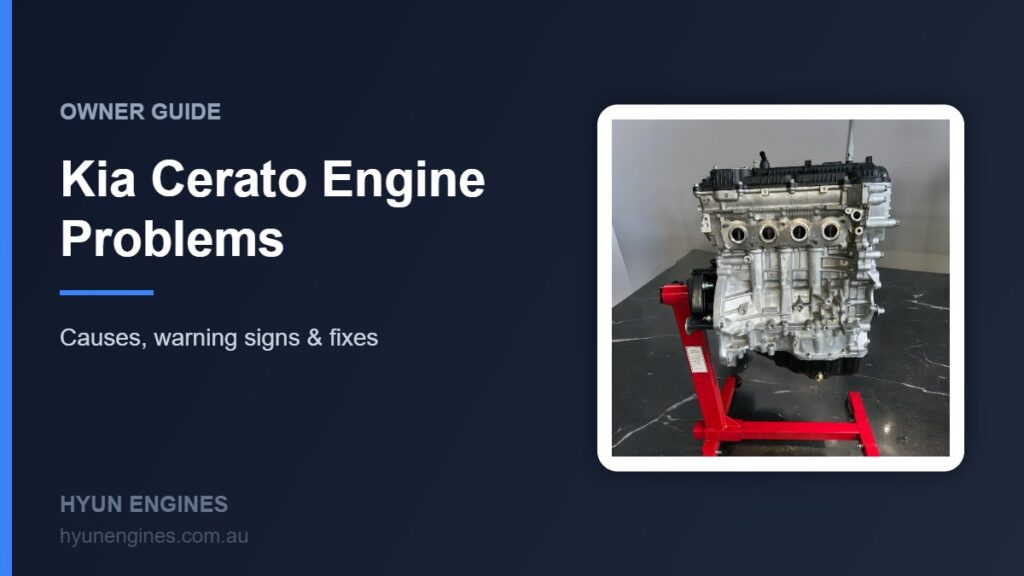
The short answer: most Kia Cerato engine problems reported in Australia involve the Nu petrol engines — the 1.8-litre G4NB (2013–2016) and the 2.0-litre G4NC (2016 onwards). Ticking noises and piston slap, oil consumption from piston ring sealing, and carbon buildup on direct-injection versions are the commonly reported complaints, and an engine run low on oil can progress to rod bearing failure.
The Cerato has long been one of Australia’s best-value small cars, and the majority run to high kilometres without major trouble. But the Nu engine family that powered the YD (2013–2018) and BD (2018 onwards) generations has a handful of well-documented weaknesses that are worth understanding, whether you already own one or are shopping used. This guide covers what goes wrong, how to spot it early and what a fix realistically costs — you can find our full model coverage on our Kia engines hub.
Common Kia Cerato engine problems
Ticking noise and piston slap
The complaint Australian Cerato owners raise most often is a ticking or light knocking noise, most noticeable on cold start and fading somewhat as the engine warms. On the Nu engines this is frequently piston slap: the clearance between piston and cylinder wall is largest when the engine is cold, and the piston rocks slightly in the bore. A little cold-start noise is common on these engines, but persistent or worsening slap matters because it accelerates piston ring and cylinder wall wear — which feeds directly into the next problem. Not every tick is a piston, either; GDI injectors are audibly clicky by design, which is why a proper diagnosis is worth having before assuming the worst.
Excessive oil consumption
Both the 1.8 G4NB and the 2.0 G4NC are commonly reported for burning oil between services with no visible leak. Piston ring sealing deteriorates with age and heat, oil gets past the rings and is burnt, and because the Cerato has no low-oil-level warning on many variants, the first sign is often a dipstick sitting one to two litres down. In the worse commonly reported cases, consumption exceeds a litre per 1,500 km. The real danger is what low oil does next: it starves the connecting rod bearings.
Rod bearing wear and engine failure
The 1.8 G4NB in particular is commonly reported for bearing failure in Australia when engines have run low on oil or gone long between changes. A worn big-end bearing produces a deep knock that rises with engine speed, and a spun bearing typically means the engine is beyond economical repair. This failure is almost always the end stage of unnoticed oil consumption rather than a sudden defect — which is why regular dipstick checks are the single cheapest insurance a Cerato owner has.
Carbon buildup on GDI versions
Direct-injection versions of the 2.0 G4NC spray fuel straight into the cylinder, so nothing washes the back of the intake valves. Hard carbon accumulates over tens of thousands of kilometres, producing rough cold idle, hesitation under throttle, poorer fuel economy and occasional misfire codes. Carbon that migrates into the piston ring grooves can also stick the oil-control rings — one of the mechanisms behind the oil consumption issue above. Port-injected (MPI) versions largely avoid the valve deposits but share the ring-sealing weakness.
Timing chain rattle at higher kilometres
The Nu engines use a timing chain rather than a belt, and on higher-kilometre G4NB and G4NC engines chain stretch and tensioner wear are commonly reported — usually announced by a rattle in the first seconds after a cold start that fades as oil pressure comes up. Chains are designed to last the life of the engine, but extended oil change intervals accelerate wear, and a badly stretched chain can eventually skip teeth and put the valve timing out. A persistent cold-start rattle is worth investigating early, while it is still a chain-and-tensioner job rather than an engine job.
What about recalls?
The Cerato’s Nu engine issues have generally been handled as wear-and-tear complaints rather than safety recalls in Australia, and the Australian class action over defective Hyundai and Kia engines includes certain Nu GDI-engined vehicles among the affected group. Recall and campaign coverage is a VIN-level question that changes over time, so check with Kia Australia using your VIN rather than relying on overseas lists.
Which Kia Cerato engines tend to have trouble?
Australian-delivered Ceratos of this era used three main petrol engines. The table below maps each code to the models it powered and the issues most commonly reported for it.
| Engine code | Fitted to | Years (AU) | Known issues |
|---|---|---|---|
| G4NB 1.8 Nu MPI | Cerato YD S, Si, SLi | 2013–2016 | Piston slap and ticking, oil consumption, rod bearing failure when run low on oil — the most complained-about Cerato engine. |
| G4NC 2.0 Nu (GDI/MPI) | Cerato YD facelift and BD (S, Sport, Sport+) | 2016–2021 | Oil consumption from ring sealing, ticking when cold, intake valve carbon buildup on GDI versions. |
| G4FJ 1.6 T-GDi | Cerato GT (BD) | 2019 onwards | Fewer reported failures; carbon buildup and a hard-worked oil supply make strict service intervals important on the turbo. |
Frequencies here are as commonly reported by owners and workshops — plenty of well-maintained examples of every engine above reach high kilometres without drama. The pattern in the complaints is service history: Ceratos run on long oil change intervals or unknown history feature heavily; fastidiously serviced cars rarely do.
Warning signs you should not ignore
- Oil level dropping between services. Check the dipstick monthly. Needing more than about a litre every 1,500 km is outside what most workshops consider acceptable, and on a Nu engine a low level directly threatens the bearings.
- Ticking that gets louder or does not fade with warmth. Mild cold-start tick is common; a tick that persists hot, or turns into a knock, needs diagnosis.
- Deep knocking that rises with revs. The classic rod bearing symptom. Stop driving — our guide on whether you can drive with a knocking engine explains why continuing can destroy a repairable engine.
- Blue-grey exhaust smoke on start-up or under acceleration, the visible sign of oil being burnt past worn rings.
- Rough idle, hesitation or misfires on GDI versions — the usual signature of intake valve carbon buildup or fouled injectors.
- Low oil pressure warning. Treat this as an emergency and switch off as soon as it is safe to stop.
If you are inspecting a used Cerato, the same list doubles as a buyer’s checklist: start the engine stone cold and listen for slap and chain rattle, check the dipstick level and the colour of the oil, look for blue smoke on start-up, and ask for service invoices showing oil change intervals. A Cerato with a stable oil level and a full service book is a genuinely good used buy; one with a dry dipstick and no history is a gamble on the most expensive component in the car.
Why these engine problems happen
Almost every Cerato engine complaint traces back to three interacting causes. First, piston and bore design: the Nu engine’s short-skirt pistons and relatively tight oil-control ring design make it sensitive to wear — as clearances open up, slap begins and ring sealing declines. Second, oil control: once rings stop sealing, oil is burnt, the level falls, and the big-end bearings — which depend entirely on pressurised oil — start running marginal. Third, service intervals: the factory schedule allows long gaps between oil changes, and oil that stays in too long oxidises and carries carbon into the ring grooves, accelerating both the sticking-ring and bearing-wear processes. Australian driving conditions compound this: short urban trips never fully burn off contaminants, and hot-climate running works the oil harder than the schedule assumes. None of this makes the Cerato a bad car — it makes the gap between a neglected engine and a cared-for one unusually wide.
Repair or replace?
The right call depends on how far the wear has progressed. All figures below are indicative Australian ranges — get a written quote for your specific car from a qualified mechanic, ideally after a compression and leak-down test.
- Carbon cleaning (GDI versions): roughly $400–$900. Worthwhile on an engine that idles rough but holds its oil.
- Piston rings and bearings: often $3,500–$6,500 by the time the engine is out, machined and reassembled — and only viable if the bores and crankshaft are still within limits.
- Reconditioned engine, supplied and fitted: commonly $4,500–$7,500 all-up for a Cerato, depending on the engine and which ancillaries carry over.
- Used engine: cheaper up-front, but you inherit another engine of the same age with the same design weaknesses and unknown oil history.
Once an engine is knocking or has been run low on oil, replacement is usually the more economical and durable path — bearing debris circulates through the oil galleries, so patch repairs on a knocked Nu engine rarely last. A properly reconditioned engine is stripped, machined and rebuilt with new rings and bearings, which addresses the exact wear points described above; our guide on what a reconditioned engine actually is explains the process step by step. Every reconditioned engine we supply is covered by a 12-month warranty.
Related reconditioned engines
We recondition and supply Cerato engines from our Melbourne workshop, with delivery Australia-wide:
- Reconditioned Kia Cerato G4NC 2.0 engine — rebuilt with new piston rings and bearings to address the known oil-control and wear weaknesses of the Nu engine.
Frequently Asked Questions
Why is my Kia Cerato making a ticking noise?
The most common causes are piston slap on a cold Nu engine, normal GDI injector noise, or valvetrain wear. A tick that fades as the engine warms is usually benign; one that persists, gets louder or deepens into a knock points to piston or bearing wear and needs diagnosis by a qualified mechanic promptly.
Is Kia Cerato oil consumption normal?
Some consumption is normal on any engine, but needing more than about a litre every 1,500 km between services is commonly regarded as excessive on the Nu engines. Have the piston rings assessed before the next service rather than simply topping up, because sustained low oil is what turns a ring problem into a bearing failure.
What does a Kia Cerato engine replacement cost in Australia?
Indicatively, a reconditioned Cerato engine supplied and fitted commonly lands between $4,500 and $7,500, depending on the engine code, freight and which ancillaries transfer across. A rebuild of your existing engine can cost similar money with more downtime, and is only worthwhile if the bores and crankshaft are still serviceable.
How long does a Cerato engine replacement take?
With the reconditioned engine on hand, most workshops complete a Cerato engine swap in two to four working days, including transferring ancillaries and road testing. Freight adds a few days outside Melbourne. Our guide on how long engine replacement takes covers the full timeline.
Was there an Australian recall for Cerato engine problems?
The Nu engine’s ticking and oil consumption issues have not been the subject of an Australian safety recall, though certain Nu GDI-engined vehicles fall within the Australian class action over Hyundai and Kia engine defects. Campaign coverage is determined at the VIN level, so check with Kia Australia using your VIN.