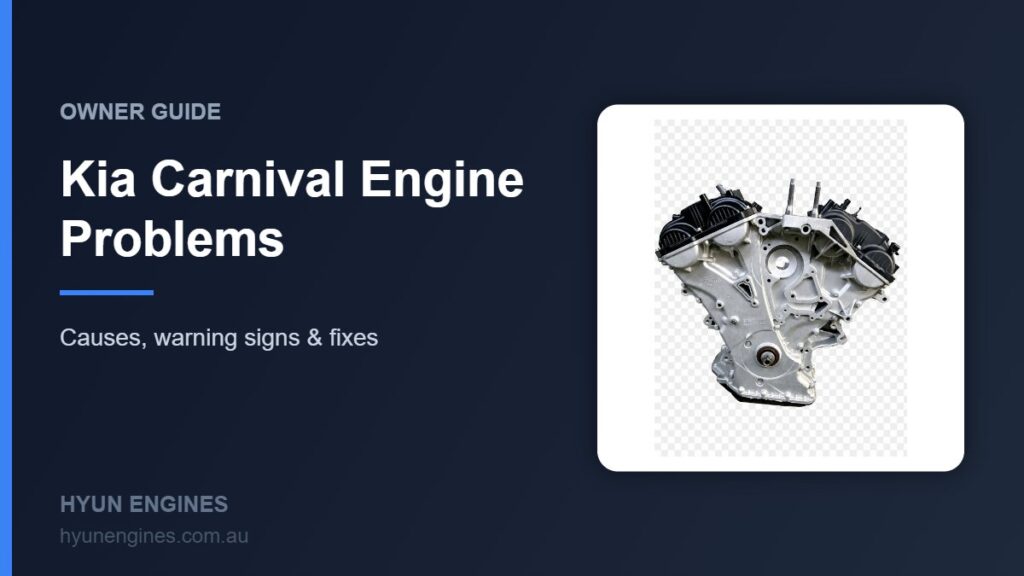
The short answer: The Kia Carnival YP (2015–2020) petrol 3.3-litre G6DH V6 is fundamentally robust, but oil leaks from the timing cover and rocker cover areas, carbon buildup on the intake valves and occasional hesitation are commonly reported as kilometres climb. The 2.2 diesel is generally reliable when its DPF, EGR and oil services are kept up.
Common Kia Carnival engine problems
The third-generation Carnival YP was one of Australia’s favourite people movers, sold here with either the 3.3-litre petrol V6 (G6DH) or the 2.2-litre turbo-diesel (D4HB). Neither engine has the widespread failure history of Kia’s four-cylinder Theta II family, but both have patterns worth knowing about before problems become expensive. Knowing which engine sits under your bonnet matters, because the two share almost nothing in how they fail, what the warning signs look like or what a fix costs.
- Timing cover oil leaks (petrol V6). The most commonly reported complaint on the Lambda II V6. The sealant between the timing cover and the block can weep with age and heat cycling, leaving oil on the front of the engine and drips under the car. It is a labour-intensive repair because so much has to come off the front of the engine to reseal it properly.
- Rocker cover and oil sender leaks (petrol V6). Valve cover gaskets harden over time and seep onto the exhaust side of the engine, producing a burning-oil smell. Oil pressure sender units are another commonly reported leak point on this engine family.
- Carbon buildup on GDI engines. The direct-injection G6DH does not wash its intake valves with fuel, so carbon accumulates on the valve backs. Symptoms include rough cold idle, hesitation on light throttle and gradually softer performance, especially on Carnivals that spend their lives on short school-run trips.
- Hesitation and rough running. Beyond carbon, commonly reported causes include coil packs and injectors on higher-kilometre engines. A Carnival that stumbles under light load deserves diagnosis before the problem masks something more serious.
- Diesel-specific care items (D4HB). The 2.2 CRDi diesel is the volume seller in Australia and has a good reputation, but it depends on regular oil changes and enough highway running to keep the DPF regenerating. Commonly reported issues on neglected examples include EGR and intake soot buildup, DPF blockages from short-trip use, and injector wear at higher kilometres.
- Servicing access on the V6. Not a fault as such, but worth knowing: the transverse-mounted V6 packs a lot of engine into the Carnival’s bay, so jobs on the rear bank – spark plugs, coils and gaskets – carry more labour than owners expect. Budgeting for proper servicing avoids the deferred maintenance that causes most of the problems above.
Which Kia Carnival engines tend to have trouble?
Australian YP Carnivals came with two engines, and the character of their problems is quite different.
| Engine code | Fitted to | Years (approx.) | Known issues |
|---|---|---|---|
| G6DH 3.3L Lambda II GDI V6 (petrol) | Carnival YP S, Si, SLi, Platinum (petrol variants) | 2015–2020 | Timing cover and rocker cover oil leaks, oil sender leaks, intake valve carbon buildup, hesitation on higher-kilometre engines |
| D4HB 2.2L CRDi turbo-diesel | Carnival YP diesel variants (majority of AU sales) | 2015–2020 | DPF and EGR soot buildup with short-trip use, injector wear at high kilometres, sensitive to missed oil services |
Note that the reconditioned Carnival engine we stock is the petrol G6DH V6; diesel owners are welcome to contact us to discuss options. For the wider range, see our Kia engines hub page covering everything we recondition for the brand.
Warning signs you should not ignore
A Carnival engine rarely fails without warning. These are the signs that should send you to a qualified mechanic promptly:
- Oil spots under the front of the vehicle or oil wetness on the front timing cover area of the V6. A slow weep is cheap to monitor; a heavy leak can starve the engine of oil.
- A burning oil smell after driving, typically from rocker cover oil reaching hot exhaust components.
- The oil level dropping between services. V6 Carnivals that leak and burn a little oil can quietly run low, and low oil is how a healthy engine becomes a damaged one.
- Rough idle, hesitation or misfires, particularly when cold – the classic signature of GDI carbon buildup or failing coils.
- Knocking or rattling noises. Any deep bottom-end knock is serious on any engine. Our guide on driving with a knocking engine explains why parking the car is almost always the right call.
- On diesels, frequent DPF regeneration messages or excessive smoke, which point to soot loading and deserve attention before a blocked filter or damaged turbo follows.
Why these engine problems happen
Most Carnival petrol issues come down to age, heat and design trade-offs rather than a fundamental defect. The Lambda II V6 uses sealant rather than a conventional gasket in places around the timing cover, and after years of heat cycling the bond can begin to weep. It is gradual, which is why leaks are usually spotted at services long before they become dangerous – provided the oil level is actually checked.
Carbon buildup is inherent to direct injection. Oil vapour from the crankcase ventilation system settles on the intake valves, and with no fuel spray to wash it off, it bakes into hard deposits. Short urban trips, which are exactly what most Carnivals do, accelerate the process. The same applies to the diesel’s EGR and DPF systems: they are designed to clean themselves at sustained highway temperatures that a school-run vehicle may rarely reach.
Unlike the four-cylinder Theta II engines fitted to models such as the Optima and Sportage, the G6DH V6 has not been the subject of the same bearing-failure recalls. That said, Kia has run various recall and service campaigns in Australia over the years, so it is always worth confirming your vehicle is up to date – check with Kia Australia using your VIN, and see our summary of Hyundai and Kia engine recalls in Australia for how the campaigns work.
Prevention on both engines comes down to habits. Check the oil monthly – a leaking and lightly consuming V6 can drop below the safe mark well before the next service. Use quality fuel and the correct oil grade, and give the vehicle a decent highway run regularly; it keeps a diesel’s DPF regenerating properly and helps a petrol GDI engine run hot enough to slow deposit formation. If a V6 develops cold-start roughness or hesitation, have the intake inspected for carbon before replacing parts on guesswork. These are cheap disciplines compared with the cost of an oil-starved engine, and they are the difference between a Carnival that reaches 300,000 km and one that needs a replacement engine at 180,000 km.
Repair or replace?
Because most Carnival V6 problems are external (leaks) or intake-related (carbon), many are repairable at sensible cost. Replacement only enters the conversation when the engine has been run low on oil or overheated. All figures below are indicative Australian ranges and vary by workshop and location.
- Rocker cover gaskets: roughly $400–$900 for the V6, depending on access.
- Timing cover reseal: roughly $1,500–$3,000 – the parts are cheap but the labour is substantial.
- Intake valve carbon cleaning (walnut blasting or manual): roughly $600–$1,200.
- Full rebuild of a damaged engine: roughly $5,000–$9,000 for a V6 once machining is involved.
- Reconditioned replacement engine: typically $3,500–$6,000 for the engine, or roughly $6,000–$9,500 fitted. For an engine that has been oil-starved, overheated or is knocking, this is usually the more economical and faster path than rebuilding the original.
A straight swap is also quicker than a rebuild – our guide on how long an engine replacement takes walks through the typical timeline. And if you are weighing up a reconditioned unit against a used engine of unknown history, remember that a reconditioned engine has been fully stripped, machined and rebuilt with new wear components, while a used engine simply carries over whatever condition – and whatever leaks – it left the donor vehicle with.
The economics usually favour repair or replacement over selling. Eight-seat people movers hold their value strongly in Australia, and a Carnival YP with a fresh engine is worth far more than the same vehicle advertised as not running. For families who already own child seats, roof racks and a car that fits their life, putting a reconditioned V6 into a tidy Carnival is generally cheaper than changing vehicles – and you know exactly what you are getting.
Related reconditioned engines
We stock the reconditioned petrol V6 for the Carnival YP, rebuilt in Melbourne with new bearings, rings, gaskets and seals – including a properly resealed timing cover – and covered by a 12-month warranty, with freight available Australia-wide.
- Reconditioned Kia Carnival G6DH engine – the 3.3-litre Lambda II GDI V6 fitted to petrol YP Carnivals.
We also carry reconditioned engines for other Kia models, such as the Kia Rondo G4NC 2.0L engine, so if you run more than one Kia in the family fleet it is worth asking what we have on the shelf.
Frequently Asked Questions
Is the Kia Carnival 3.3 V6 a reliable engine?
Broadly, yes. The G6DH does not share the rod-bearing failure history of Kia’s Theta II four-cylinders. Its commonly reported problems – timing cover and rocker cover oil leaks, carbon buildup and hesitation – are age-related and manageable if caught early and the oil level is watched between services.
Why is my Kia Carnival leaking oil?
On the petrol V6, the usual suspects are the timing cover sealant, rocker cover gaskets and the oil pressure sender. A workshop can pinpoint the source with a degrease and dye check. Small weeps can be monitored, but a leak that drops the oil level between services should be repaired promptly.
Was the Kia Carnival part of the Theta II engine recall?
No. The Theta II campaigns concerned 2.0 and 2.4-litre four-cylinder engines in models such as the Optima, Sportage and Sorento. The Carnival YP’s V6 and diesel are different engine families. Kia has still run other campaigns over the years, so check with Kia Australia using your VIN to confirm yours is up to date.
Petrol or diesel Carnival – which engine lasts longer?
Both can pass 300,000 km with care. The diesel suits owners who do regular highway kilometres, which keeps the DPF healthy; the petrol V6 is simpler and better suited to urban use, provided its oil leaks are managed and the intake is decarboned when symptoms appear. Service history matters more than fuel type.
Do you supply reconditioned Carnival engines outside Melbourne?
Yes. We are Melbourne-based and freight engines Australia-wide to workshops and private buyers. Our stocked Carnival engine is the petrol G6DH V6 – browse it in our online shop, or call with your VIN and we will confirm fitment for your exact build date before dispatch.