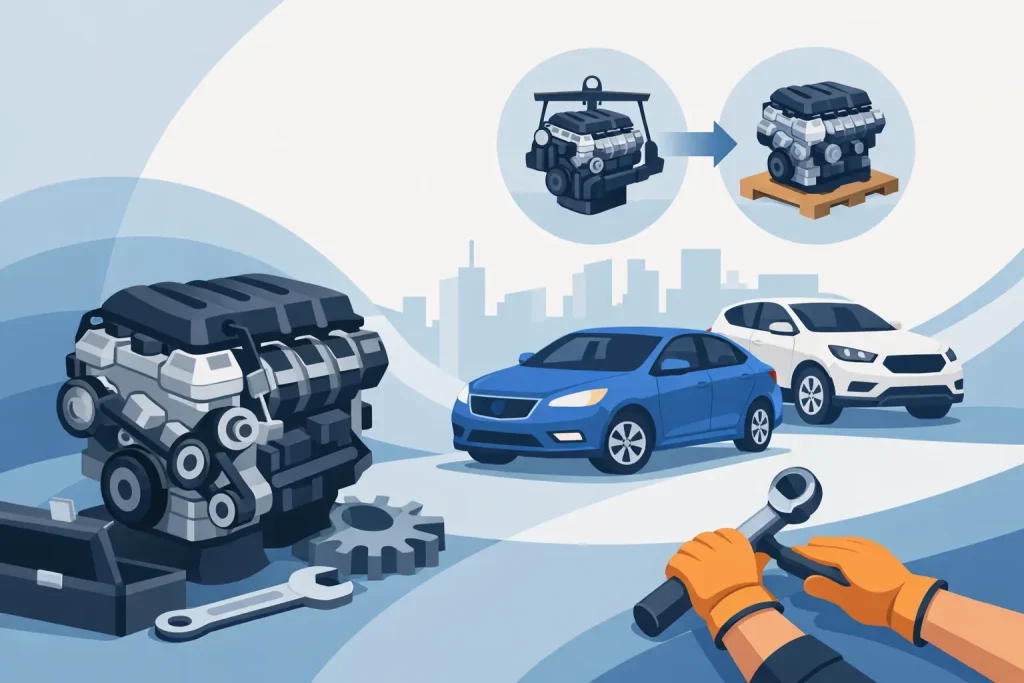
When your Hyundai starts knocking, burning oil, losing compression or simply stops without warning, the question gets expensive fast. The best Hyundai engine replacement options depend on the fault, the model, your budget and how long you plan to keep the vehicle. There is no single right answer for every iLoad, i30, Tucson or Santa Fe – but there is usually a clear best fit once the problem is properly diagnosed.
For most owners, the real decision is not just replacement versus repair. It is whether a used engine, a reconditioned engine, an engine rebuild or a brand-new long motor makes the most sense. Each option comes with different costs, timeframes, risks and long-term value. If you choose based on price alone, you can easily end up paying twice.
How to judge the best Hyundai engine replacement options
Before looking at parts prices, start with the condition of the vehicle itself. A relatively tidy Hyundai with a sound transmission, straight body and good service history is often worth investing in. If the rest of the car is tired, has major gearbox issues or has already had repeated cooling and electrical faults, a cheaper path may be more sensible.
The engine failure also matters. A snapped timing chain, spun bearing, cracked block, overheated cylinder head and piston slap do not all point to the same solution. Some failures damage only a few internal components. Others contaminate the entire engine with metal and make a simple repair poor value.
Then there is intended use. A family SUV doing school runs and weekend trips has different needs to an iLoad used by a tradie every day. If downtime costs you work, the fastest reliable solution can be the best one even if the upfront figure is higher.
Option 1: Used engine replacement
A used engine is often the cheapest way to get a Hyundai back on the road. This usually means a complete second-hand engine sourced from a wrecked or dismantled vehicle, then fitted into yours with the required ancillaries swapped over where needed.
This option can work well when the donor engine has sensible kilometres, has been tested properly and matches your engine code exactly. For older vehicles with limited resale value, a used engine can be the most practical decision. It keeps costs under control and avoids spending beyond what the car is worth.
The trade-off is uncertainty. Even with checks, you are still buying an engine with a past life you did not witness. Service history is not always complete, and some issues only appear once the engine is heat-cycled under load. Diesel engines, in particular, need careful assessment because injector, turbo and oiling problems may not be obvious at first glance.
A used engine makes the most sense when budget is the main factor, the vehicle is older, and the supplier can offer proper testing and a meaningful warranty. Without those safeguards, cheap can become very expensive.
Option 2: Reconditioned engine
For many owners, this sits in the sweet spot. A reconditioned engine is generally a used engine that has been stripped, inspected and rebuilt to a defined standard using new internal components where required. Depending on the engine and the damage, that may include bearings, rings, gaskets, timing components, seals, pistons, machining work and cylinder head repairs.
Among the best Hyundai engine replacement options, a reconditioned engine is often the strongest balance of cost and confidence. You are not paying full new-engine money, but you are also not gambling on an unknown wrecking-yard motor. Done properly, it gives you a tested unit with the common wear points addressed.
This matters on Hyundai engines known for timing issues, oil consumption, overheating damage or bottom-end wear. Reconditioning allows those known weak points to be inspected and corrected before the engine goes back into service. That usually gives better long-term value than fitting an untouched used engine and hoping for the best.
The key phrase here is done properly. Reconditioned is sometimes used loosely in the market. A cleaned engine with a few seals replaced is not the same as one that has been measured, machined, rebuilt and tested by a specialist workshop. Ask what has actually been replaced, what machining was carried out and what warranty applies.
Option 3: Rebuild your original engine
An engine rebuild means your original Hyundai engine is removed, stripped and repaired rather than swapped for another unit. This can be an excellent option when the core engine is rebuildable and the rest of the vehicle is worth keeping.
The biggest advantage is control. You know the engine code matches, you retain your original motor, and the workshop can see exactly what failed. That is especially useful where the cause of failure needs to be traced properly, such as oil starvation, cooling system faults or timing chain problems. Rebuilding can also be the better path when there are model-specific variations that make direct engine swaps less straightforward.
The downside is time. Rebuilds can take longer than replacing the engine with a ready-to-fit unit, particularly if machining, parts sourcing or head work is needed. Cost can also climb if the strip-down reveals more damage than first expected. A rebuild that starts with bearings and rings can become much larger if the crankshaft, block or head is beyond limits.
Still, if the original engine is salvageable and the job is handled by Hyundai specialists, a rebuild can offer strong value and a very sound result.
Option 4: Brand-new engine or long motor
A new engine is the premium option. It offers the highest level of component freshness and, in many cases, the lowest mechanical risk. For newer Hyundais with high value, or for owners planning to keep the car long term, it can be the right call.
The issue is cost. New engines are usually the most expensive path by a wide margin, and availability can vary by model. Once labour, fluids, belts, timing parts, seals and related items are added, the total can exceed what many owners want to put into an older vehicle.
Where it does make sense is on late-model vehicles, lower-kilometre cars in otherwise excellent condition, or commercial vehicles where reliability matters more than initial spend. Fleet operators sometimes choose this route because predictable uptime is worth more than the savings of a cheaper engine.
Which option suits common Hyundai scenarios?
If you have an older i30 or Tucson with substantial kilometres, a tested used engine or a reconditioned engine often makes the most financial sense. If it is a well-kept diesel SUV or people mover that still has plenty of life left in the transmission and body, a reconditioned engine or rebuild is usually the smarter long-term choice.
For an iLoad used for work, reliability and turnaround tend to matter more than squeezing every dollar. A quality reconditioned replacement can be a strong result because it balances speed with durability. For a newer vehicle with good resale value, a new engine becomes easier to justify.
This is where specialist advice matters. A general workshop may quote the easiest option, not necessarily the best one. A Hyundai-focused engine workshop will usually have seen the same faults across the same engine families many times before and can tell you where money is well spent and where it is not.
What to check before agreeing to any engine replacement
No matter which path you take, ask the workshop what caused the original engine failure. If the root issue is not fixed, the replacement engine can suffer the same fate. Cooling system faults, injector issues, blocked oil pick-ups, failed turbos, contaminated DPF systems and timing component wear all need attention around the engine job, not after it.
You should also ask whether installation includes related service items. New seals, filters, fresh fluids, timing parts where appropriate, and inspection of turbo and fuel systems are not small details. They are part of doing the job properly.
Warranty matters too, but only if the terms are clear. A short warranty with a long list of exclusions is less useful than a straightforward warranty backed by a workshop that actually fits Hyundai and Kia engines every week. Hyun Engines, for example, works within a licensed and insured workshop environment, which gives customers one point of responsibility from diagnosis through to fitment.
The best Hyundai engine replacement options are the ones that match the car
There is no magic answer that suits every owner. A used engine can be the right budget fix. A reconditioned engine is often the best all-rounder. A rebuild can be ideal when your original engine is worth saving. A brand-new motor suits vehicles where maximum reliability outweighs cost.
What matters most is not choosing the cheapest quote or the fastest promise. It is choosing the option that fits the condition of the vehicle, the way you use it and the quality of support behind the job. When you get that balance right, an engine replacement stops feeling like a disaster and starts looking like a sensible way to keep a good Hyundai on the road.
Frequently Asked Questions
What are my options when a Hyundai engine fails?
The main options are repairing the existing engine, fitting a rebuilt engine, or installing a reconditioned replacement. For most out-of-warranty Hyundais, a reconditioned engine offers the best balance of cost, reliability and turnaround.
Is a reconditioned Hyundai engine a good replacement option?
Yes. A reconditioned engine is inspected, machined where needed and tested to restore reliable performance at a fraction of the cost of new, and ours come with a 12-month warranty.
How much do reconditioned Hyundai engines cost?
Most start from around $4,200, with larger or turbo-diesel units priced higher. Every price includes a 12-month warranty and free Australia-wide shipping.
Do you supply and fit Hyundai engines?
Yes. We supply Australia-wide and can fit the engine at our Dandenong workshop, typically within 2-3 days.