Ask this question on any Australian car forum and you’ll get everything from “bulletproof” to “ticking time bomb”. The truth sits in between, and it depends heavily on which engine is under the bonnet. We recondition Hyundai and Kia engines every week, so we see exactly which families come through our Dandenong workshop and why. Here’s an honest, engine-by-engine answer.
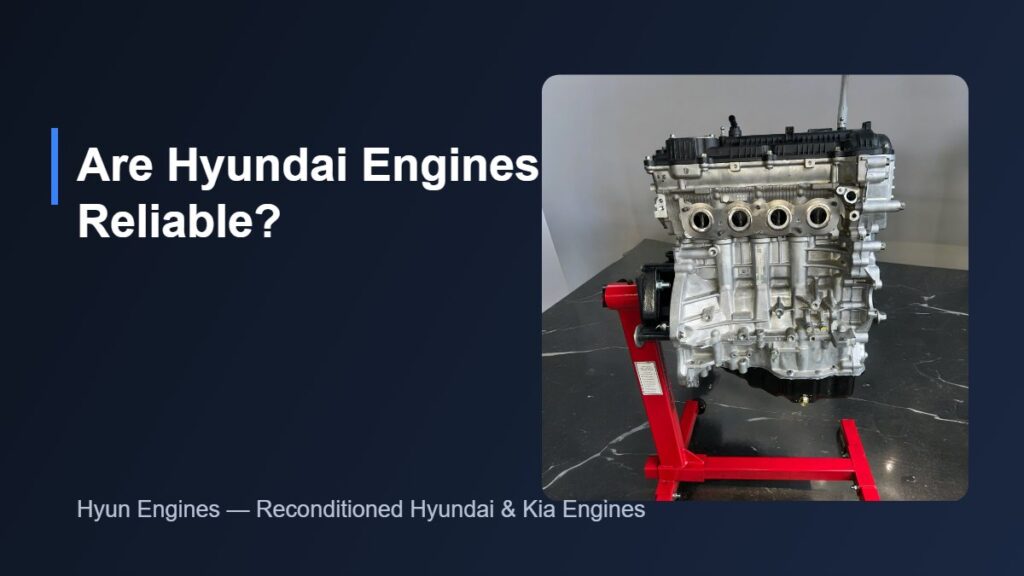
The short answer: Most Hyundai engines are reliable when serviced properly, but reliability varies by family. The Gamma small engines are genuinely tough, the diesels are strong workhorses, while the Nu petrol engines can burn oil at higher kilometres and the Theta II family has a well-documented rod bearing history. The weak points are well known — and all fixable.
How reliable are Hyundai engines overall?
Modern Hyundais routinely see out 200,000 km and beyond, and the brand’s engineering has improved sharply since the early 2000s. But two patterns show up consistently in the engines that reach our bench: oil-related wear on some direct-injection petrol families, and the consequences of stretched service intervals. Almost every “bad Hyundai engine” story traces back to one of a handful of known engine-family issues, or to oil that stayed in the sump too long. Knowing which engine you have — the code is stamped on the block and listed against your VIN — tells you most of what you need to know.
What about the Nu engines (G4NB and G4NC)?
The Nu family — the 1.8-litre G4NB (i30, Elantra, roughly 2011–2017) and 2.0-litre G4NC (later i30, Tucson) — is the one we see most. These are decent engines with one dominant complaint at higher kilometres: oil consumption. Worn or stuck piston rings let oil past into the combustion chamber, and because many owners don’t check the dipstick between services, the first symptom is often a rattle from an engine running low on oil. Carbon build-up on the GDI versions and timing chain stretch on hard-driven examples round out the list.
The good news: it’s a well-understood, fixable problem. We’ve written up the detail in why is my Hyundai losing oil, and when an engine is too far gone, reconditioned exchange units like our i30 G4NB engine and Tucson G4NC engine have new rings, bearings and machined bores — the wear points engineered back to spec.
What’s the story with the Theta II (G4KJ)?
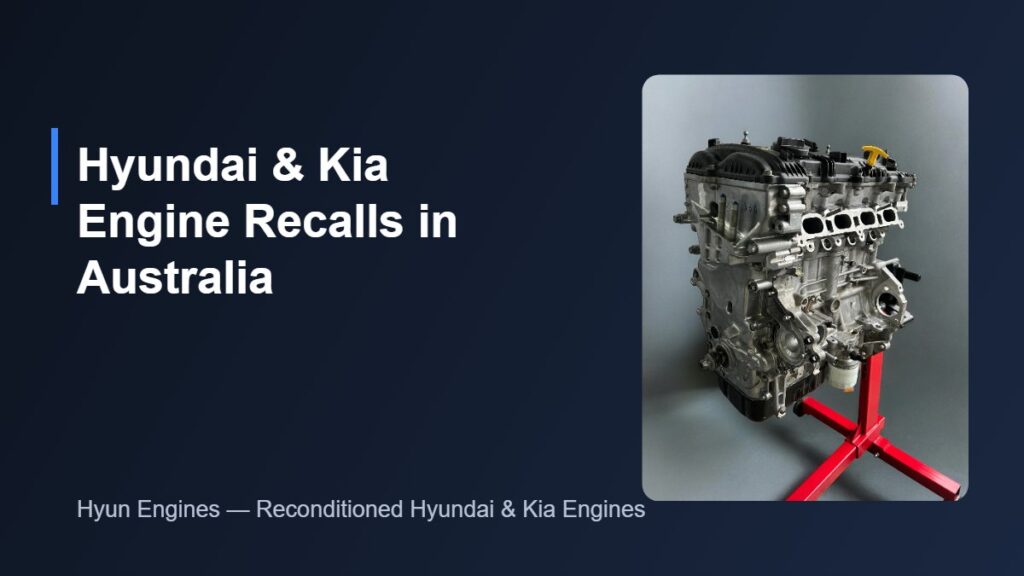
The Theta II family — including the 2.4-litre G4KJ — is the one behind most of the scary headlines. Worldwide, these engines developed a documented history of premature connecting rod bearing wear, in part linked to manufacturing debris in the crankshaft oil passages; a failing bearing can knock, seize, or let a rod exit the block. The concern reached Australia formally too: recall campaign 21D150, issued for 2014–17 Tucson 2.0 vehicles, covered premature connecting rod bearing failure that could cause engine damage, oil leaks and, in the worst case, fire risk.
If you own an affected car: check your VIN with Hyundai for outstanding recalls, and treat any new metallic knock — especially at idle or under light load — as urgent. Caught early, a bottom-end rebuild saves the engine; ignored, it’s a full replacement. We cover the symptoms in detail in our Hyundai Tucson engine problems guide.
Are the smaller Gamma engines (G4FC/G4FA) any good?
Yes — genuinely. The 1.6-litre G4FC and 1.4-litre G4FA fitted to the i20, Accent, i30 and Cerato are among the most reliable engines Hyundai and Kia have built. They’re simple, understressed multi-point injection designs, and with regular oil changes they routinely pass 250,000 km. The complaints we do see are minor by comparison: some timing chain noise at high kilometres and tappet-style rattle on cold start. If you’re shopping used Hyundais on a budget, a Gamma-engined car is the low-risk pick.
How do the Hyundai diesels hold up?
Strongly — with one condition. The D4CB 2.5 (iLoad, iMax), D4HA 2.0 CRDi and D4HB 2.2 CRDi (Santa Fe, and the Kia Sorento) are torquey, durable engines that regularly clock big kilometres in commercial use. The condition is servicing: common-rail diesels punish neglect. Short-trip city running clogs DPFs, stretched oil intervals wear the turbo and injectors, and the D4CB in hard-worked iLoads needs its oil changes on time to protect the bottom end. Serviced properly, these are 300,000 km engines; serviced casually, they’re expensive.
Hyundai engine reliability at a glance
| Engine family | Codes | Common in | Known weak points | Verdict |
|---|---|---|---|---|
| Gamma 1.4/1.6 | G4FA, G4FC | i20, Accent, i30, Cerato | Minor chain noise at high km | Very reliable |
| Nu 1.8/2.0 | G4NB, G4NC | i30, Elantra, Tucson | Oil consumption at higher km, carbon build-up | Good, watch the oil level |
| Theta II 2.4 | G4KJ | Sonata, Santa Fe (and Kia models) | Rod bearing wear history; AU recall 21D150 covered 2014–17 Tucson 2.0 rod bearings | Check recalls, act on any knock |
| Diesels 2.0–2.5 | D4CB, D4HA, D4HB | iLoad, Tucson, Santa Fe | Injectors, DPF and turbo if servicing is neglected | Strong with on-time servicing |
So what’s the honest verdict?
Hyundai engines are reliable — with maintenance, and with eyes open about your specific engine family. The weak points aren’t mysteries: they’re documented, predictable, and every one of them is fixable. Check the oil level monthly on a Nu engine, take any bottom-end knock on a Theta II seriously, and service the diesels on time, and these cars deliver long, cheap-to-run lives.
And if your engine is already past saving, it’s not the end of the car. Hyun Engines has specialised in reconditioned Hyundai and Kia engines since 2014 — every engine we sell is reconditioned and tested, comes with a 12-month warranty, and can be supplied and fitted at our workshop at 8 Hammond Rd, Dandenong VIC 3175. Call (03) 9630 0960, Monday to Friday 9am–5pm, for straight advice on your engine code.
Frequently Asked Questions
Which Hyundai engine is the most reliable?
The Gamma family (G4FA 1.4 and G4FC 1.6) has the best record in our experience — simple, understressed engines that regularly exceed 250,000 km with basic servicing. The diesels are close behind when maintained on schedule.
How do I find out which engine my Hyundai has?
The engine code (e.g. G4NB, G4NC, G4KJ, D4HB) is stamped on the engine block and recorded against your VIN. Your VIN also lets Hyundai check for outstanding recalls — worth doing for any 2014–17 Tucson given campaign 21D150.
Is Hyundai oil consumption normal?
Some oil use at higher kilometres is common on Nu-family GDI engines, but needing a top-up between services isn’t something to ignore — it accelerates wear and can starve the engine if unchecked. Check the dipstick monthly and investigate rising consumption early.
Should I avoid buying a used Hyundai because of the engine recalls?
No — but buy informed. Confirm the engine code, check the VIN for completed recalls, look for service history, and listen for knocks on a cold start. A Gamma or well-serviced diesel is low risk, and even the higher-risk families are fine cars with a documented healthy engine or a reconditioned replacement.