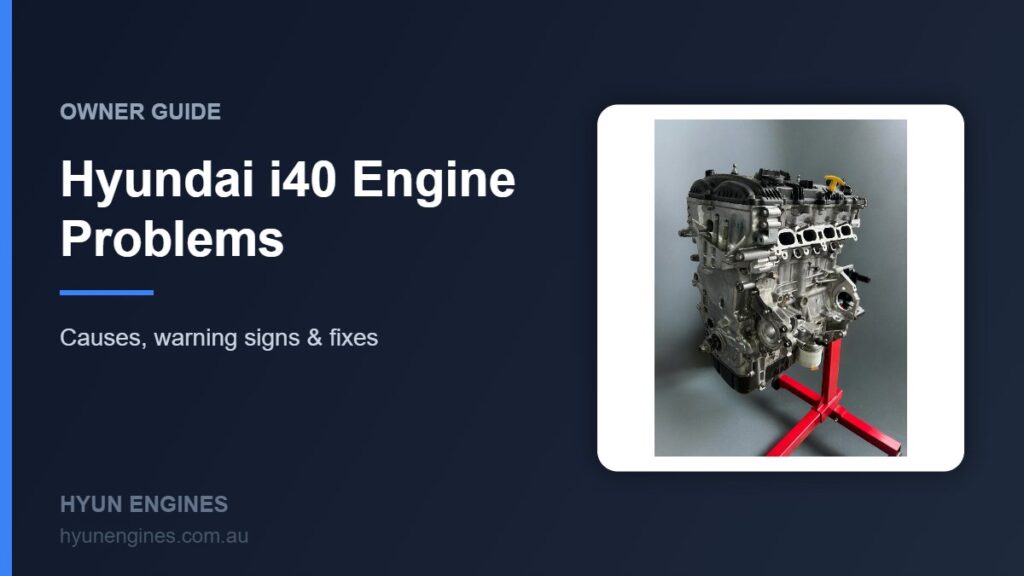
The short answer: the Hyundai i40’s 2.0-litre Nu GDI petrol engine (G4NC) is most commonly reported for excessive oil consumption, intake carbon buildup and timing chain rattle at higher kilometres, while the 1.7 CRDi diesel (D4FD) attracts complaints about blocked diesel particulate filters, oil dilution and injector faults. Neither engine is inherently bad, but both punish patchy servicing and short-trip driving.
Common Hyundai i40 engine problems
The i40 (VF series) was sold in Australia from 2011 to 2019 as a sedan and Tourer wagon, with a choice of the 2.0 GDI petrol or 1.7 turbo-diesel. Each has its own pattern of complaints.
Oil consumption on the 2.0 GDI petrol
The G4NC belongs to Hyundai’s Nu engine family, and like its i30 sibling it is commonly reported for burning oil as kilometres climb. The usual mechanism is carbon from combustion blow-by lodging in the piston ring grooves and sticking the oil-control rings, so they stop scraping oil off the cylinder walls. Consumption typically creeps up gradually — a top-up here and there — until the engine is using a litre or more between services. Because the low-oil warning only triggers when the level is critically low, many engines suffer bearing wear before the owner realises anything is wrong.
Carbon buildup on intake valves
As a direct-injection engine, the G4NC sprays petrol straight into the cylinder, so no fuel washes over the intake valves to keep them clean. Hard carbon deposits build on the valves and ports over tens of thousands of kilometres, producing rough cold idle, hesitation, misfire codes and worsening fuel economy. It is the same well-documented GDI trait found across the Hyundai and Kia range.
Timing chain wear
The G4NC uses a timing chain that should last the engine’s life, but stretched oil change intervals accelerate chain and tensioner wear. A rattle for the first few seconds of a cold start is the classic early symptom, and a chain that skips teeth can put valve timing out badly enough to damage the engine, so it is not a noise to sit on.
Injector tick and high-pressure fuel pump noise (petrol)
A ticking noise from the top of the 2.0 GDI, most noticeable when cold, worries plenty of i40 owners but is often normal. Direct-injection systems run at very high fuel pressures, and both the injectors and the high-pressure pump are audibly clicky by design, quietening as the engine warms. The time to investigate is when ticking arrives together with misfires, rough running or a check engine light — that combination points to fouled injectors rather than ordinary GDI noise, and is worth a proper diagnosis before it affects the catalytic converter.
Diesel problems: DPF, oil dilution and injectors (D4FD 1.7 CRDi)
The 1.7 CRDi is a story of duty cycle. Its diesel particulate filter needs regular sustained highway running to regenerate; i40 diesels that live in suburbia are commonly reported for blocked DPFs, reduced power and warning lights. Failed regenerations also dump unburnt diesel into the sump — owners finding the oil level rising above the full mark is a well-known i40 diesel complaint, and diluted oil accelerates engine wear. Add injector faults that trigger limp mode and the occasional early turbocharger failure, and a neglected 1.7 CRDi can become an expensive proposition. We do not stock the diesel — for i40 owners facing a big diesel repair bill, a reconditioned 2.0 petrol engine in a petrol i40, or moving the budget to a petrol replacement vehicle, is often the more economical path. Petrol i40 owners are better served on both parts availability and repair cost.
Which i40 engines tend to have trouble?
Unlike the i30, which cycled through five petrol engines over the same period, the Australian i40 range is simple: one petrol and one diesel across its whole 2011–2019 run. That makes identification easy — if your i40 takes unleaded, it has the G4NC; if it takes diesel, it has the D4FD. The engine code is also stamped on the block and listed on many service invoices if you want to confirm it before ordering parts or a replacement engine.
| Engine code | Fitted to | Years (AU) | Known issues |
|---|---|---|---|
| G4NC 2.0 Nu GDI petrol | i40 Active, Elite, Premium (sedan and Tourer) | 2011–2019 | Oil consumption from sticking oil-control rings, intake valve carbon buildup, timing chain rattle at high km. |
| D4FD 1.7 CRDi diesel | i40 diesel variants (sedan and Tourer) | 2011–2019 | DPF blockage from short-trip use, rising oil level from failed regenerations, injector faults causing limp mode, occasional turbo failure. |
Frequencies are as commonly reported by Australian owners and workshops rather than official failure rates. The G4NC is shared with the 2017-on i30, Tucson and Kia Sportage, which is good news for parts and reconditioned engine availability. Well-serviced examples of both engines can cover big distances — our article on how long Hyundai engines last sets out what realistic life expectancy looks like.
Warning signs you should not ignore
- Oil level falling between services (petrol). Check the dipstick monthly; more than about a litre per 1,500 km is beyond what most workshops consider acceptable.
- Oil level rising above full (diesel). Almost always diesel dilution from failed DPF regenerations — have it seen to promptly.
- Cold-start rattle that lasts a few seconds and is getting louder, pointing to timing chain or tensioner wear.
- Knocking under acceleration. Deep rhythmic knock rising with revs suggests bearing damage — stop driving and get a diagnosis.
- DPF or engine warning lights, limp mode or heavy exhaust smoke on the diesel.
- Rough idle, hesitation or misfires on the petrol, typical of carbon buildup or fouled injectors.
With both engines, early attention is the difference between a repair bill and an engine bill. A petrol i40 caught while it is merely using oil can often be saved with a carbon clean and new rings; one driven until it knocks needs a complete engine. Likewise, a diesel with a partially blocked DPF can often be recovered with a forced regeneration, while one driven for months with diluted oil may have worn its bearings beyond saving. Checking the dipstick monthly — for a falling level on the petrol, a rising one on the diesel — costs nothing and catches both failure modes early.
Why these engine problems happen
The petrol engine’s issues trace back to direct injection. With no fuel washing the intake valves, carbon builds unchecked, and blow-by gases recirculated through the PCV system deposit carbon in the ring grooves, sticking the oil-control rings. Once oil starts getting past the pistons it burns, leaves more carbon behind, and the cycle feeds itself. Long factory service intervals make it worse: oil left in for 15,000 km sludges and loses the additives that keep rings free and chains tensioned. The diesel’s issues are largely usage-pattern driven — the DPF and injection system were engineered around sustained highway running, and Australian school-run duty never gets the exhaust hot enough to self-clean. In both cases, shorter oil change intervals, quality fuel and a regular highway run prevent most of the trouble. None of this is unique to the i40; it reflects industry-wide traits of GDI petrol and DPF-equipped diesel engines of this era, as we discuss in our review of Hyundai engine reliability.
Repair or replace?
Because the i40 was discontinued in Australia in 2019 and used values are modest, the repair-versus-replace maths deserves a clear head. The good news is that the car around the engine tends to age well — the VF-series i40 is well equipped, comfortable and cheap to keep on the road once the engine is sorted, which is why many owners choose to fix rather than sell when a big bill arrives. Indicative Australian price ranges below — always get a written quote from a qualified mechanic for your specific vehicle:
- Intake carbon clean (petrol): roughly $400–$900, worthwhile on a rough-idling but otherwise healthy engine.
- DPF clean or replacement (diesel): roughly $500 for a forced regeneration or professional clean, $2,000–$4,000+ for a new filter.
- Diesel injectors: commonly $500–$900 per injector, fitted.
- Timing chain and tensioner: roughly $1,200–$2,500.
- Full rebuild of a worn G4NC: often $4,000–$7,000 once machining, parts and labour are counted — see our breakdown of engine reconditioning costs in Australia.
- Reconditioned G4NC engine, supplied and fitted: commonly $4,500–$7,500 all-up.
If the petrol engine is knocking, heavily consuming oil or has scored bores, replacing it with a reconditioned engine usually beats rebuilding the tired original on both cost and outcome — you receive a machined, tested engine with new wear components rather than a repair to a damaged core, and ours are backed by a 12-month warranty. If you are weighing it up, our explainer on what a reconditioned engine is covers exactly what gets replaced during reconditioning.
Related reconditioned engines
We recondition the i40’s petrol engine in our Melbourne workshop and deliver Australia-wide:
- Reconditioned Hyundai i40 G4NC 2.0-litre engine — rebuilt with new rings and bearings to address the known oil-control weaknesses.
- Reconditioned Hyundai i30 G4NC 2.0 engine (2017 onwards) — the same Nu engine family as the i40, useful if you also run an i30, Tucson or Sportage.
You can browse the full range of reconditioned Hyundai and Kia engines in our shop.
Frequently Asked Questions
Is the Hyundai i40 2.0 petrol engine reliable?
Reasonably, with caveats. The G4NC is commonly reported for oil consumption and carbon buildup as kilometres rise, but examples serviced every 7,500–10,000 km with quality oil routinely avoid serious trouble. On any used i40, check the service history and confirm the oil level holds steady between changes before buying.
Why is the oil level rising in my i40 diesel?
Rising oil level in the 1.7 CRDi is almost always diesel dilution: failed DPF regenerations let unburnt fuel drain into the sump. It needs prompt attention because diluted oil loses its protective properties and can damage the engine. A qualified diesel specialist should assess the DPF and regeneration behaviour.
Do you sell the i40 1.7 CRDi diesel engine?
No — we stock reconditioned petrol engines only, including the i40’s 2.0-litre G4NC. Diesel repairs on the D4FD (DPF, injectors, turbo) are usually handled at component level by diesel specialists. If your petrol i40 needs an engine, we can supply a fully reconditioned G4NC ready to fit.
Was the Hyundai i40 recalled in Australia for engine problems?
The i40 appeared in Australian recall campaigns shared with other Hyundai models, but the oil consumption, carbon and DPF issues described here were never the subject of an Australian recall. Check your VIN at vehiclerecalls.gov.au for anything outstanding on your car before paying for related repairs.
Is it worth replacing the engine in a Hyundai i40?
Often, yes. The i40 is a comfortable, well-equipped car that is cheap to buy used, so a reconditioned engine at $4,500–$7,500 fitted (indicative) can be far better value than changing cars, especially on a tidy Tourer wagon. Have a mechanic confirm the rest of the driveline is healthy first.