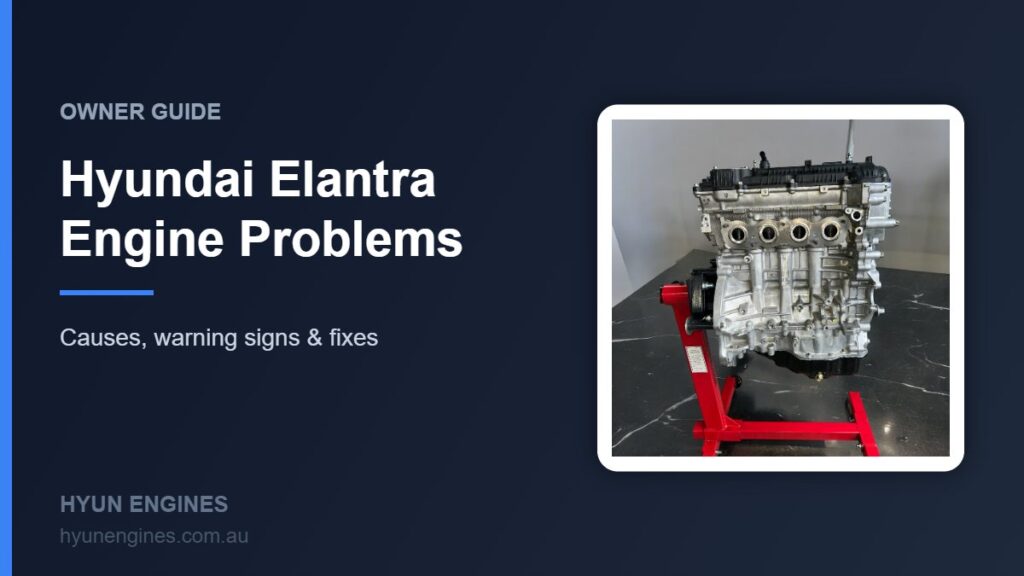
The short answer: Most Hyundai Elantra engine problems trace back to the Nu engine family — cold-start piston slap and ticking on the 1.8-litre G4NB (2011–2015 MD), rising oil consumption as the kilometres climb, and carbon buildup on direct-injection 2.0-litre versions. Caught early, many issues are repairable; once the bottom end is worn, a reconditioned engine is usually the more economical fix.
The Elantra has been one of Australia’s most popular small sedans, and for the most part it has earned a reputation as dependable, affordable transport. But no engine family is perfect, and the Nu-series petrol engines fitted to Australian-delivered Elantras have a few well-documented weak points that owners and mechanics see again and again. This guide covers what goes wrong, which engines are affected, the warning signs to watch for, and what a repair or replacement is likely to cost in Australia.
Common Hyundai Elantra engine problems
Cold-start piston slap and ticking (1.8 G4NB)
The most commonly reported complaint on the 2011–2015 Elantra MD is a ticking or light knocking noise on cold start-up that fades as the engine warms. The usual cause is excess clearance between the piston and the cylinder bore: when the engine is cold, the piston rocks slightly in the bore and its skirt taps the cylinder wall. As the alloy piston expands with heat, the clearance closes up and the noise settles down.
In mild cases the noise is more annoying than harmful, and some engines tick for years without failing. In worse cases the wear progresses — the ticking no longer disappears when warm, oil consumption climbs, oil-fouled spark plugs trigger misfire codes, and eventually the bottom end lets go. In the United States, piston-related ticking and premature wear in 1.8 Nu engines led to a class action and an extended short-block warranty for affected owners. Australian-delivered cars were not part of that settlement, so local owners generally deal with the issue out of warranty.
Oil consumption
Commonly reported on both the 1.8 and 2.0 Nu engines, particularly past 100,000 km. The usual culprits are oil-control rings that gum up and stick in their grooves, and hardened valve stem seals. Consumption often creeps up slowly — half a litre between services, then a litre, then more — which is exactly why it catches owners out. An engine that runs low on oil between services is an engine heading towards bearing damage, so once consumption becomes measurable it needs to be watched closely.
Connecting rod bearing wear and knock
A deeper, rhythmic knock from the bottom of the engine — especially under load — points to worn big-end bearings. This is less common than ticking or oil use, but it is the most serious of the three, because a spun or seized bearing typically destroys the crankshaft and block. If you are hearing a genuine knock, read our guide on whether you can drive with a knocking engine before you turn the key again — the honest answer is that every extra kilometre adds risk.
Carbon buildup on GDI engines
Direct-injection (GDI) versions of the 2.0 Nu spray fuel straight into the cylinder, so petrol never washes over the back of the intake valves. Over time, oil vapour from the crankcase ventilation system bakes onto the valves as hard carbon. Symptoms include rough cold idle, hesitation, reduced power and worsening fuel economy. It is a gradual, maintenance-related issue rather than a defect, but it is commonly reported on higher-kilometre GDI engines.
Oil sludge from stretched service intervals
Nu engines are not especially tolerant of neglected servicing. Extended oil-change intervals, constant short-trip driving and cheap oil accelerate sludge formation, which blocks the oil pickup screen and small galleries — and that is how ticking engines become knocking engines.
Which Hyundai Elantra engines tend to have trouble?
Australian-delivered Elantras of this era used closely related Nu-family engines. The 1.8 G4NB attracts the most complaints; the 2.0-litre versions are generally stronger but share the family’s appetite for oil at high kilometres.
| Engine code | Fitted to | Years | Known issues |
|---|---|---|---|
| G4NB 1.8 Nu MPI | Elantra MD (also Hyundai i30 GD) | 2011–2015 | Cold-start piston slap and ticking, oil consumption, oil sludge if neglected, rod bearing wear in severe cases |
| G4NA 2.0 Nu MPI | Elantra AD (multi-point-injection variants; also Tucson) | 2016–2020 | Oil consumption at higher kilometres, occasional rod bearing wear |
| G4NC 2.0 Nu GDI | Elantra AD (direct-injection variants; also i30) | 2016 onwards | Intake valve carbon buildup, oil consumption, high-pressure fuel system wear |
Worth knowing: at the time of writing there was no broad Hyundai Australia recall covering piston or bearing defects in these Elantra engines. Some related Hyundai engines were recalled in other markets, so if you want certainty for your exact car, check with Hyundai Australia using your VIN. Our summary of Hyundai and Kia engine recalls in Australia explains how to run that check in a few minutes.
Warning signs you should not ignore
- Ticking that no longer fades when warm. A cold-start tick that disappears is worth monitoring; a tick that persists at operating temperature means wear has progressed.
- Oil level dropping between services. Check the dipstick monthly. Consumption beyond roughly a litre per 1,500 km is a genuine problem, not “normal for the age”.
- Deep knocking under acceleration. The classic bottom-end warning. Stop driving and have the car inspected.
- Blue-grey exhaust smoke on start-up or overrun. Points to valve stem seals or worn oil-control rings.
- Misfire codes and oil-fouled spark plugs. Often the first measurable evidence of oil finding its way into the combustion chambers.
- Metal flakes in the oil or on the drain plug. Bearing material in the oil means the engine is on borrowed time.
These signs matter just as much if you are shopping for a used Elantra. Start the car stone cold at inspection — a seller who has warmed the engine before you arrive may be masking a cold-start tick. Pull the dipstick and check both the level and the condition of the oil, look for a service history with consistent intervals, and be wary of any car where the low level or dark, thick oil suggests the dipstick has not been checked in months. A pre-purchase inspection by a qualified mechanic is cheap insurance on a 1.8 MD in particular.
Why these engine problems happen
The Nu family was engineered for light weight and low friction — an alloy block, short-skirt pistons and low-tension piston rings all help fuel economy, but they leave less margin for wear. Piston-to-bore clearance that is quiet when new becomes audible slap as bores and skirts wear. Low-tension oil-control rings save fuel but gum up more readily, which is where the oil consumption starts.
Direct injection adds its own quirk: with no fuel washing the intake valves, carbon accumulates unchecked, and Australia’s stop-start urban driving makes it worse. Finally, heat and long service intervals degrade oil faster than many owners expect. None of this makes the Elantra a bad car — plenty run well past 250,000 km — but it rewards owners who service on time and check the dipstick. For the bigger picture, see our honest assessment of whether Hyundai engines are reliable.
Repair or replace?
The right call depends on what has actually worn. Indicative Australian price ranges:
- Carbon cleaning (GDI engines): roughly $400–$900 for walnut blasting of the intake valves at a qualified workshop.
- Valve stem seals or minor top-end work: roughly $1,200–$2,500 depending on access and parts.
- Piston slap or heavy oil consumption: there is no cheap fix — resolving it properly means new pistons and rings at minimum, plus machining. A full rebuild typically runs $3,500–$6,000 or more once the engine is apart.
- Rod bearing failure: by the time it knocks, the crankshaft and block are usually damaged, and repairing the original engine rarely makes financial sense.
Two other factors are worth weighing. The first is downtime: a rebuild of your own engine means the car sits for whatever time the machine shop needs, whereas a ready-built replacement engine is typically a few days’ workshop labour to swap in. The second is certainty — a rebuild quote is an estimate until the engine is stripped, and hidden crank or bore damage can add thousands mid-job, while a replacement engine is a known, fixed price up front.
For a worn bottom end, a professionally reconditioned engine — rebuilt with new pistons, rings and bearings and freshly machined surfaces — usually costs less than rebuilding your own engine from scratch, and gets the car back on the road faster. Our guide to engine reconditioning costs in Australia breaks the numbers down in detail. As a rule of thumb, a reconditioned Nu engine supplied and fitted by a qualified mechanic lands in the $4,000–$7,000 range depending on the variant — often around half what a dealership quotes for a factory replacement long block.
Related reconditioned engines
We stock fully reconditioned Nu engines to suit both generations of Elantra. Each is rebuilt to address the known wear points covered above — new pistons, rings and bearings, machined and pressure-tested — and backed by a 12-month warranty:
- Reconditioned Hyundai Elantra G4NB 1.8 engine — suits 2011–2015 Elantra MD
- Reconditioned Hyundai Elantra G4NC 2.0 engine — suits direct-injection 2.0-litre Elantra AD
Not sure which engine your car runs? Send us your VIN or rego and we will confirm fitment before you order.
Frequently Asked Questions
Is the ticking noise in my Elantra serious?
It depends on behaviour. A light tick on cold start that fades within a few minutes is commonly reported on the 1.8 G4NB and can stay stable for years. A tick that persists once warm, gets steadily louder, or deepens into a knock indicates progressing wear and should be inspected by a qualified mechanic promptly.
How much oil consumption is normal for an Elantra?
A healthy Nu engine should use very little oil between services. The occasional top-up on a high-kilometre engine is not alarming, but consumption beyond roughly one litre per 1,500 km suggests stuck oil-control rings or worn seals. Track it with regular dipstick checks and act before the level ever runs low.
Was there an Australian recall for Elantra engine problems?
At the time of writing there was no broad Hyundai Australia recall covering piston or bearing defects in the G4NB or G4NC Elantra engines. Related engines were recalled in overseas markets, so the safest step is to check with Hyundai Australia using your VIN — any outstanding recall work is done free of charge.
How long do Elantra engines last?
With on-time servicing and quality oil, Australian Elantra engines commonly pass 200,000–250,000 km. Neglected examples can fail much earlier, especially where sludge or chronically low oil is involved. Regular oil changes and monthly dipstick checks are the two habits that matter most for Nu engine longevity.
Is a reconditioned engine better than a second-hand one?
For these engines, usually yes. A used engine from a wrecker carries the same wear-prone pistons, rings and bearings you are trying to escape. A properly reconditioned engine has those components renewed and its machined surfaces restored, so the known Nu weak points are addressed rather than inherited.