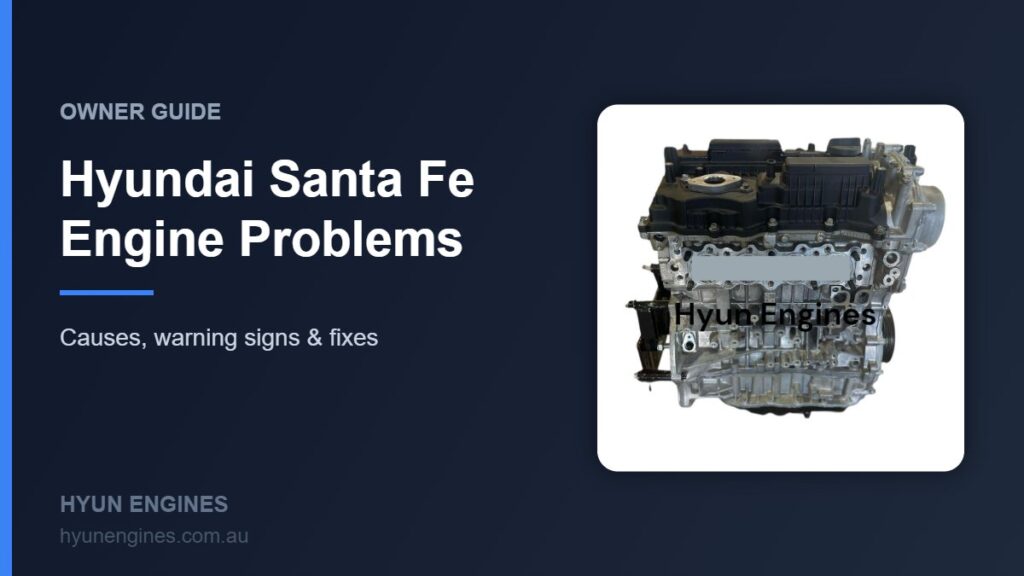
The short answer: The Hyundai Santa Fe’s petrol 2.4-litre G4KJ Theta II GDI engine is commonly reported to suffer connecting rod bearing wear, oil consumption and carbon buildup, and certain early builds were recalled in Australia. The 2.2 CRDi diesel is generally tougher but has its own EGR, DPF and injector issues. Caught early, many problems are fixable; a worn bottom end usually means a reconditioned engine.
Common Hyundai Santa Fe engine problems
The Santa Fe has been one of Australia’s most popular seven-seat SUVs, and most examples on our roads are the DM (2012–2018) and TM (2018–2020) generations. Locally they were sold with two mainstream engines: the 2.4-litre G4KJ Theta II GDI petrol and the 2.2-litre D4HB CRDi turbo-diesel. The petrol engine is where the serious, engine-ending problems concentrate.
- Connecting rod bearing wear (2.4 GDI). The defining Theta II problem worldwide. Restricted oil flow to the rod bearings causes premature wear, a metallic knock that rises with engine speed and, if ignored, bearing failure that can seize the engine while driving. This is the failure behind the global Theta II recalls and the related Australian campaign.
- Excessive oil consumption (2.4 GDI). Commonly reported from around 100,000–150,000 km. Worn rings and scored cylinder walls let oil into the combustion chamber, so the level drops between services. Low oil then starves the same rod bearings that are already the engine’s weak point — a vicious cycle.
- Intake valve carbon buildup (2.4 GDI). Direct injection means fuel never washes the backs of the intake valves, so carbon accumulates over time. Symptoms are rough idle, cold-start misfires, hesitation under throttle and slowly worsening fuel economy.
- Timing chain stretch. Reported on higher-kilometre Theta II engines, especially with patchy servicing: front-of-engine rattle, a check engine light and camshaft correlation codes. A badly stretched chain can jump teeth and bend valves.
- EGR and intake carbon fouling (2.2 diesel). The D4HB’s EGR valve and intake manifold clog with carbon over time — commonly reported around the 150,000 km mark — causing rough idle, poor throttle response, limp mode and emissions fault codes.
- DPF blockages (2.2 diesel). Diesel Santa Fes used mainly for short urban trips often cannot complete DPF regeneration, leading to blocked-filter warnings and limp mode. Leaking injectors or a stuck EGR valve accelerate soot loading.
- Diesel injector and fuel system issues. Injector faults and, on some build periods, fuel filter problems are reported on the D4HB. These are repairable but should be addressed promptly, as poor injection quality damages the DPF and can wash cylinder bores.
Which Santa Fe engines tend to have trouble?
The table below covers the two engines fitted to the vast majority of Australian-delivered DM and TM Santa Fes. Note that our stocked reconditioned Santa Fe engine is the petrol G4KJ.
| Engine code | Fitted to | Years | Known issues |
|---|---|---|---|
| G4KJ 2.4 GDI (Theta II petrol) | Santa Fe DM and TM petrol variants (mainly Active and Elite 2WD) | 2012–2020 | Rod bearing wear, oil consumption, intake carbon buildup, timing chain stretch; subject of Theta II recall campaigns |
| D4HB 2.2 CRDi (turbo-diesel) | Santa Fe DM and TM diesel variants (Active, Elite, Highlander AWD) | 2012–2020 | EGR and intake carbon fouling, DPF blockages, injector faults; bottom end generally durable |
The petrol G4KJ is the same engine family fitted to the Series II ix35 and the Tucson that followed it, so the symptoms and fixes carry across — see our companion guide to Hyundai Tucson engine problems for the smaller SUVs.
Warning signs you should not ignore
Theta II failures usually announce themselves before the engine lets go. Acting on the first symptom is the difference between a manageable repair and a complete engine replacement.
- Metallic knocking that rises with revs — the classic rod bearing symptom on the 2.4. Stop driving and get the car inspected immediately.
- Oil level dropping between services. More than about a litre between changes means the rings or bores are wearing. Check the dipstick monthly on any Theta II petrol.
- Blue exhaust smoke on start-up or under load — burning oil.
- Oil pressure warning light. Pull over and shut the engine off; oil starvation can destroy a Theta II bottom end within minutes.
- Rough idle, misfires or hesitation on the petrol — often carbon buildup, sometimes coils or injectors.
- Repeated DPF warnings or limp mode on the diesel — a sign the filter, EGR system or injectors need attention before damage spreads.
- Metal particles in the engine oil at service time — bearing material circulating. The engine is living on borrowed time.
The same list works as a pre-purchase checklist. On a petrol Santa Fe, start the engine cold and listen for knock or rattle, check the dipstick level and oil condition, watch for blue smoke under hard acceleration, and insist on service invoices — a 2.4 with documented on-time oil changes is a far safer buy than one without history. On a diesel, ask when the EGR and intake were last cleaned and whether the car has done mostly highway or urban kilometres. A pre-purchase inspection by a qualified mechanic is cheap insurance either way.
Why these engine problems happen
The petrol engine’s problems trace back to a well-documented manufacturing issue. In the Theta II GDI engines, metal debris left over from machining the crankshaft could restrict oil flow to the connecting rod bearings, causing premature wear and, in the worst cases, seizure. This triggered enormous recalls in the United States and South Korea — and in June 2017 Hyundai Australia recalled certain i45 and Santa Fe vehicles fitted with the 2.4 GDI engine over the same connecting rod bearing concern. Later service campaigns added knock-detection software to some Theta II vehicles. Coverage is strictly VIN-specific, so check with Hyundai Australia using your VIN; our summary of Hyundai and Kia engine recalls in Australia explains the campaigns in more detail.
Design and usage play a part too. Direct injection leaves the intake valves unwashed by fuel, so carbon builds relentlessly, particularly on cars doing short urban runs. The Theta II is also unusually sensitive to oil condition: extended service intervals, cheap oil or a slightly low level dramatically accelerate bearing and bore wear. A heavy seven-seater that tows, carries the family and idles in traffic in Australian heat works its oil hard.
The diesel’s issues are different in kind. The D4HB bottom end is generally durable, but its emissions hardware — EGR, intake and DPF — slowly chokes with carbon, especially in stop-start driving. These are maintenance-and-repair items rather than engine-ending flaws, which is why high-kilometre diesel Santa Fes are common while the petrol needs a closer look before purchase.
Repair or replace?
Always start with a proper diagnosis by a qualified mechanic — a compression and leak-down test, oil pressure test and a cut-open oil filter checked for metal will establish whether the bottom end is worn. Indicative Australian prices:
- Intake valve carbon cleaning (petrol): roughly $400–$900.
- EGR and intake cleaning (diesel): roughly $500–$1,200 depending on how much is dismantled.
- DPF cleaning or replacement (diesel): roughly $600–$3,500 depending on whether the filter can be cleaned or must be replaced.
- Timing chain kit replacement (petrol): roughly $1,200–$2,500.
- Reconditioning your existing engine: commonly $3,500–$8,000 for a full Theta II rebuild with machining, new pistons, rings and bearings — see our guide to engine reconditioning costs in Australia.
- Exchange reconditioned engine, supplied and fitted: commonly $4,500–$8,000 all up, and usually quicker because the engine is already built — typical downtime is covered in our guide on how long an engine replacement takes.
The rule of thumb: carbon, EGR, DPF and chain problems are worth repairing. Once there is confirmed bearing knock, heavy oil consumption or metal in the oil on the 2.4 petrol, partial repairs rarely hold — the wear is distributed through the engine, and a properly reconditioned exchange engine is the more economical fix over anything beyond the short term.
Weigh the repair against the whole vehicle, too. A Santa Fe with a sound body, transmission and interior is an expensive car to replace like-for-like, and a reconditioned engine typically costs a fraction of changing over to a comparable newer SUV once stamp duty and the unknowns of another used car are counted. If the rest of the car is tired as well — transmission, suspension, accident history — the sums change. Ask your mechanic to assess the car as a whole before committing either way.
Related reconditioned engines
We stock a fully reconditioned engine for the petrol Santa Fe, rebuilt with a machined block, new bearings, rings and gaskets, and covered by a 12-month warranty. If you want to understand exactly what that rebuild involves, read our explainer on what a reconditioned engine is.
- Hyundai Santa Fe G4KJ 2.4L GDI petrol engine — suits DM and TM petrol variants
Our stocked Santa Fe engine is the petrol G4KJ; if your Santa Fe is the 2.2 CRDi diesel, contact us and we can advise on availability and options for the D4HB.
Frequently Asked Questions
Which Hyundai Santa Fe engine has the most problems?
The 2.4-litre G4KJ Theta II GDI petrol is the one with serious, engine-ending failure modes — rod bearing wear and oil consumption are commonly reported. The 2.2 CRDi diesel is generally more durable in its bottom end, with its problems concentrated in the EGR, DPF and injector systems instead.
Was the Santa Fe recalled in Australia for engine failure?
Yes. In June 2017, Hyundai Australia recalled certain i45 and Santa Fe vehicles with the 2.4 GDI Theta II engine because machining debris could restrict oil flow to the connecting rod bearings. Coverage depends on the exact vehicle, so check with Hyundai Australia using your VIN to confirm whether yours was included.
How long do Santa Fe engines last?
A well-serviced diesel D4HB commonly exceeds 300,000 km. The 2.4 petrol varies far more: well-maintained examples pass 200,000 km, while neglected ones can develop bearing or oil consumption problems from around 100,000 km. Service history and oil condition matter more than the odometer — see our guide on how long Hyundai engines last.
Can I keep driving my Santa Fe with an engine knock?
No. On the 2.4 Theta II, a knock that rises with engine speed almost always means rod bearing wear, and continued driving risks sudden seizure — dangerous in traffic and fatal for the engine. Shut it down, have the car towed to a qualified mechanic, and get the bottom end inspected before deciding anything.
Do you sell the Santa Fe diesel engine?
Our stocked Santa Fe engine is the reconditioned petrol 2.4 G4KJ GDI, which suits DM and TM petrol variants. We do not list the D4HB diesel as a stocked item, but contact us with your VIN and we can advise on current availability and the best option for your vehicle.