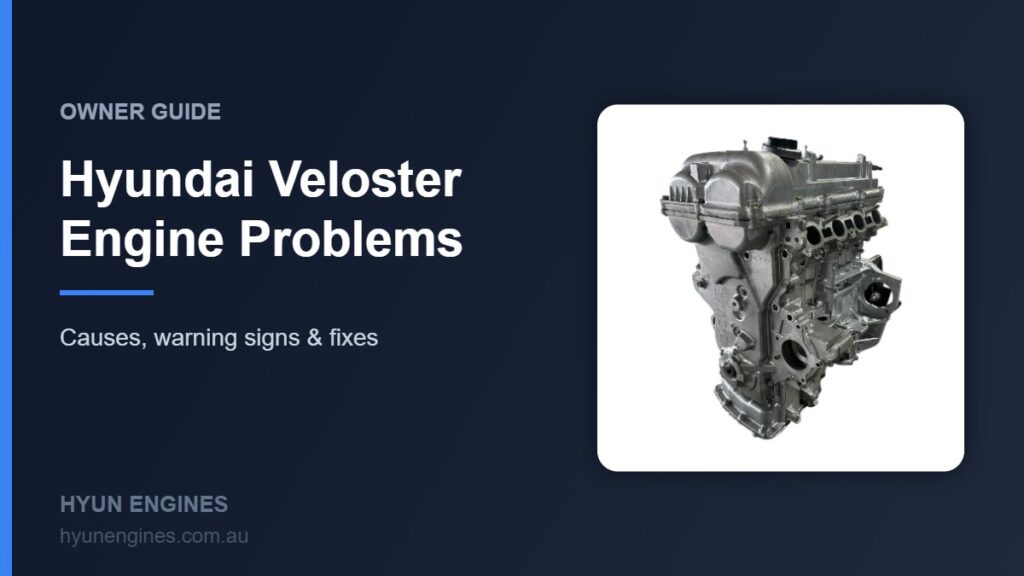
The short answer: Hyundai Veloster engine problems centre on the 1.6-litre Gamma engines — carbon buildup and oil consumption on the G4FD GDI, and wastegate rattle, oil dilution and connecting rod bearing failure on the G4FJ turbo. Hyundai Australia recalled 2015–2016 Velosters over rod bearing defects, so knocking noises on these cars must never be ignored.
The Veloster was Hyundai’s left-field coupe — three doors, sharp styling, and from 2012 to 2020 a steady seller with Australian buyers who wanted something different. Under the bonnet, though, it shared its 1.6-litre Gamma engines with more ordinary Hyundais, and those engines have a documented set of weak points, including one serious enough to trigger an official Australian recall. Here is what goes wrong, which engines are affected, and what a fix costs.
Common Hyundai Veloster engine problems
Connecting rod bearing failure
The most serious issue, and the one behind the Australian recall. Due to a manufacturing defect, the connecting rod bearings in some Veloster engines can wear prematurely. The first symptom is usually a deep knocking or rumbling from the bottom of the engine; left unchecked, the bearing can seize, punching a rod through the block, dumping oil and in the worst cases causing a sudden loss of power or even an engine fire. Hyundai’s Australian recall (REC-005722, campaign 21D150, published July 2023) covered 2015–2016 model year Veloster (FS) vehicles with the naturally aspirated 1.6-litre engine — around 13,500 cars alongside affected 2017 Tucsons. The remedy is a free engine inspection, replacement where necessary, and knock-detection software that warns the driver of early bearing wear. Rod knock reports are not limited to recalled build dates, so any bottom-end noise on any Veloster deserves immediate attention. If your Veloster has developed a knock, read our guide on whether you can drive with a knocking engine — with this failure mode, the safe answer is to stop driving and have it towed.
Turbo wastegate rattle (G4FJ)
A commonly reported complaint on the SR Turbo: a metallic rattle or tinny buzzing from the exhaust side of the engine, usually at idle or just off throttle. The culprit is the wastegate — the flap that regulates boost pressure. Wear in the wastegate actuator linkage and pivot lets the flap vibrate in the exhaust flow. It sounds alarming but is largely a nuisance in the early stages; the real cost comes if the actuator wears to the point of inconsistent boost control, which can trigger limp mode or, on neglected engines, over-boost. Fixes range from actuator adjustment to turbocharger replacement.
Carbon buildup on intake valves
Both Veloster engines are direct-injection, so fuel never washes over the back of the intake valves. Oil vapour from the crankcase ventilation system slowly bakes onto the valves as hard carbon, and by 100,000 km or so many engines show rough cold idle, hesitation under load and creeping fuel consumption. Turbo engines tend to accumulate deposits faster. It is maintenance-related rather than a defect, but it is one of the most commonly reported GDI complaints on these cars.
Oil dilution and oil consumption
Direct injection plus short-trip driving lets unburnt fuel wash past the rings and dilute the oil, thinning it exactly when the engine needs protection most — a particular concern on the turbocharged G4FJ, where the turbo bearings depend on healthy oil. At the other end of the scale, worn oil-control rings on higher-kilometre engines cause the familiar Gamma complaint of rising oil consumption. Either way, the outcome of ignoring it is the same: accelerated bearing and turbo wear.
Ignition coil and misfire complaints
Less serious but common: turbo engines are hard on ignition components, and tired coils or plugs on the G4FJ show up as stumbles under boost and misfire codes. Cheap to fix — but worth diagnosing properly, because persistent misfires on these engines can also be an early symptom of oil fouling from the issues above.
Which Hyundai Veloster engines tend to have trouble?
| Engine code | Fitted to | Years | Known issues |
|---|---|---|---|
| G4FD 1.6 Gamma GDI | Veloster FS (non-turbo, including Veloster +) | 2012–2018 | Intake valve carbon buildup, oil consumption, rod bearing failure on some 2015–2016 builds (Australian recall) |
| G4FJ 1.6 Gamma T-GDi (turbo) | Veloster SR Turbo (FS), Veloster Turbo (JS); also i30 SR | 2012–2020 | Wastegate rattle, carbon buildup, oil dilution and consumption, rod bearing knock reports, ignition wear |
The second-generation JS Veloster (2019–2020) carried the G4FJ turbo forward largely unchanged, so its watch-list is the same as the SR Turbo’s. If you are unsure whether your car was caught by the bearing recall — or whether the work was ever done — check with Hyundai Australia using your VIN. Our overview of Hyundai and Kia engine recalls in Australia walks through exactly how to do that.
Warning signs you should not ignore
- Deep knocking or rumbling from the bottom of the engine. On a Veloster this is a stop-driving-now symptom, given the documented bearing failure mode.
- An engine warning light with unusual noise or smoke. The recall notice itself tells drivers to pull over safely, switch off and call a dealer — treat it that seriously.
- Metallic rattle near the turbo at idle or light throttle. Classic wastegate wear on the G4FJ; have boost control checked before it worsens.
- Oil level dropping — or rising and smelling of petrol. Falling oil means consumption; rising, fuel-smelling oil means dilution. Both starve bearings of protection.
- Rough cold idle, hesitation and misfire codes. Typical of intake valve carbon buildup on these direct-injection engines.
- Loss of boost or limp mode. Points to wastegate or actuator faults on the turbo engine.
The same checklist applies if you are buying a used Veloster. Insist on starting the engine stone cold, listen for bottom-end noise before and after warm-up, and pull the dipstick to check the oil’s level, colour and smell. On a 2015–2016 car, ask Hyundai or check the recall register with the VIN to confirm the bearing recall work has been completed. On turbo cars, a documented history of frequent oil changes is worth more than low kilometres — a pampered 150,000 km SR Turbo is generally a safer buy than a neglected 90,000 km one.
Why these engine problems happen
The Gamma is a small-capacity, high-output engine — the turbo version makes over 150 kW from 1.6 litres — so tolerances, oil quality and heat management matter more than in a lazy large engine. The rod bearing failures trace to a manufacturing defect acknowledged in the recall, but heat and oil neglect accelerate the same wear on engines outside the affected build range.
The other issues are inherent to the technology: direct injection leaves intake valves unwashed, so carbon accumulates; cold starts and short trips let fuel dilute the oil; and a turbocharger both adds heat and depends on clean, healthy oil for its own bearings. A Veloster that gets frequent oil changes with quality oil, a proper warm-up before hard driving, and occasional highway runs will avoid most of this list. For context on the brand as a whole, see our guide to how long Hyundai engines last.
On oil specifically: the factory service schedule is a maximum, not a target. Many specialists suggest halving the drain interval on turbocharged Gamma engines used for short trips or spirited driving, and always using a quality full-synthetic oil of the correct grade. It is the single cheapest thing an owner can do to protect the rod bearings and the turbocharger — the two most expensive components on this engine’s known-issues list.
Repair or replace?
Indicative Australian price ranges for the common failure points:
- Ignition coils and plugs: roughly $300–$700 for a full refresh on the turbo engine.
- Carbon cleaning: roughly $400–$900 for walnut blasting of the intake valves.
- Wastegate actuator or turbocharger: roughly $500–$1,000 for actuator work; $2,000–$3,500 if the turbocharger needs replacement.
- Rod bearing failure: once a bearing has knocked, the crankshaft and often the block are damaged. A bottom-end rebuild typically exceeds $4,000–$6,000, and on a seized engine repair is rarely viable at all.
That last point is why many Veloster owners with a knocking or seized engine go straight to a replacement. A professionally reconditioned engine — stripped, machined, and rebuilt with new pistons, rings and bearings — resolves the known weak points rather than inheriting them, and typically costs $4,500–$7,500 supplied and fitted by a qualified mechanic, depending on variant. First check whether the recall applies to your car, because an eligible engine may be replaced by Hyundai free of charge; outside that window, a reconditioned unit is usually the most economical path back on the road.
Related reconditioned engines
We stock the reconditioned 1.6 turbo to suit the Veloster, rebuilt with new bearings, pistons and rings — directly addressing the Gamma’s documented weak points — and backed by a 12-month warranty:
- Reconditioned Hyundai Veloster Turbo G4FJ engine — suits Veloster SR Turbo (FS) and Veloster Turbo (JS)
- Reconditioned Hyundai i30 Turbo G4FJ engine — the same G4FJ engine as fitted to the i30 SR, worth cross-checking for fitment and availability
Unsure which variant you have? Send us your VIN or rego and we will confirm the correct engine before you order.
Frequently Asked Questions
Is the wastegate rattle on my Veloster Turbo serious?
Not immediately. Wastegate rattle is a commonly reported wear symptom on the G4FJ and many cars run for years with it. It becomes a problem when boost control turns inconsistent — surging, limp mode or over-boost. Have a qualified mechanic assess the actuator; adjustment is cheap compared with a turbocharger replacement later.
Was the Hyundai Veloster recalled in Australia for engine problems?
Yes. Recall REC-005722 (campaign 21D150), published in July 2023, covered 2015–2016 model year Veloster (FS) vehicles for premature connecting rod bearing wear that could cause engine seizure, loss of power or fire. The fix is free through Hyundai dealers — check with Hyundai Australia using your VIN to confirm your car’s status.
How long do Veloster engines last?
Well-maintained examples commonly exceed 200,000 km, including turbos. The gap between a Gamma that lasts and one that fails early is mostly maintenance: frequent quality oil changes, attention to oil level, and warming the engine before hard driving. Neglected turbo engines, by contrast, can fail well before 150,000 km.
Can carbon buildup on a Veloster be prevented?
It can be slowed significantly. Quality oil changed on time reduces the vapour that forms deposits, regular highway driving helps keep valves hot enough to limit accumulation, and periodic walnut-blast cleaning restores lost performance. Because both Veloster engines are direct-injection, fuel additives alone cannot clean the intake valves — the fuel never touches them.
My Veloster engine has seized — is it worth replacing?
Usually, yes. Velosters hold their appeal and there is no newer equivalent model, so a drivetrain fix often makes better financial sense than changing cars. First confirm recall eligibility with Hyundai Australia; failing that, a reconditioned G4FJ typically returns the car to service for a fraction of its replacement value.